
Our Latest Articles
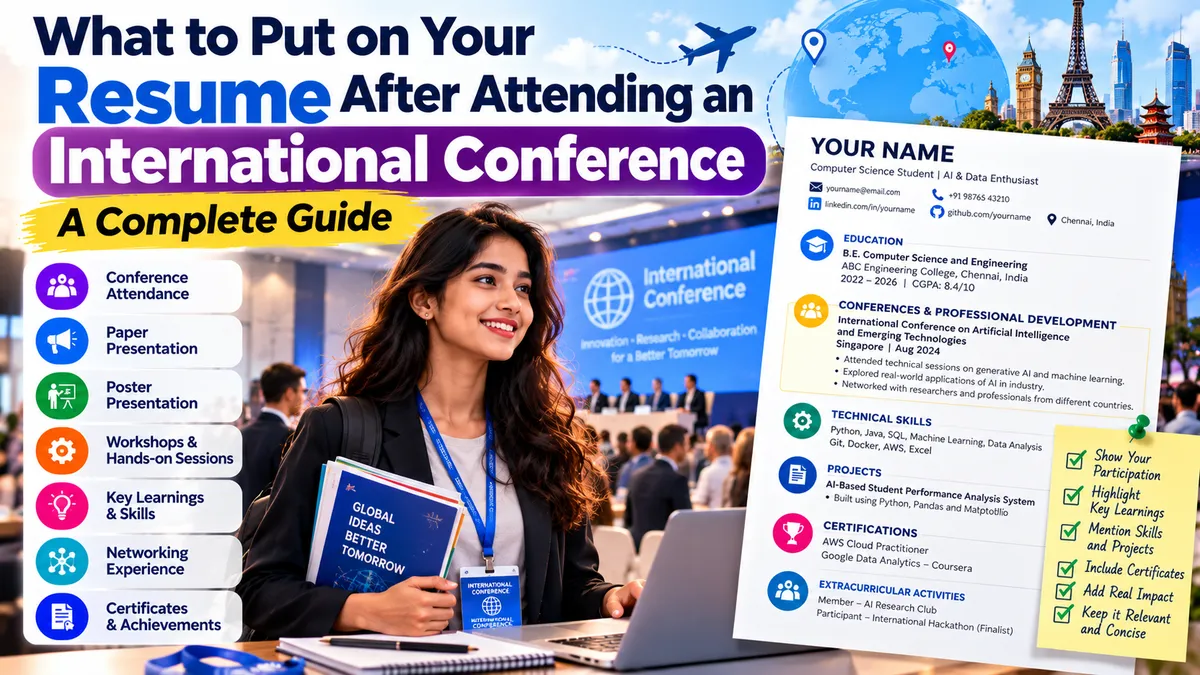
What to Put on Your Resume After Attending an International Conference
Attending an international conference can be a valuable experience for students, researchers, and technology professionals. It provides opportunities to explore emerging technologies, learn from experts, understand global industry trends, and connect with people from different countries.
However, after attending a conference, many people face a common question: How should they include this experience on their resume?
Simply writing “Attended an International Conference” may not be enough. Your resume should highlight the conference's relevance, your participation, what you learned, and any contributions or achievements.
In this guide, you will learn how to add international conference experience to your resume, with practical examples for students, researchers, and technology professionals.
1. Why Is International Conference Experience Valuable?
International conference participation can demonstrate your interest in continuous learning and professional development.
Depending on the event and your level of participation, it may highlight:
Technical knowledge and awareness of emerging technologies.
Research interests and academic engagement.
Communication and presentation skills.
Exposure to international perspectives.
Professional development and industry awareness.
Interest in innovation and new ideas.
Participation in workshops, demonstrations, and technical discussions.
For students applying for internships, scholarships, higher education, or international career opportunities, relevant conference experience can complement academic qualifications, technical skills, and projects.
Remember that attending a conference does not automatically demonstrate expertise. Your resume should accurately reflect what you learned and accomplished.
2. Where Should You Add Conference Experience to Your Resume?
Choose the resume section that best represents your participation.
Conferences and Professional Development
Use this section if you attended a conference to learn about industry trends, research, or emerging technologies.
Conference Presentations
Use this section if you presented a research paper, technical talk, or poster.
Publications
If your research paper was published in official conference proceedings, list it under Publications with the correct publication details.
Research Experience
If the conference was connected to your research project, dissertation, or academic work, you may include relevant contributions in this section.
Workshops and Technical Training
Use this section for practical workshops, hands-on technical sessions, or structured training completed during a conference.
Tip: If you only attended the event, a Conferences and Professional Development section is usually appropriate. If you presented research, highlight that contribution separately.
3. What Information Should You Include?
A clear resume entry should contain the following information where relevant:
Official conference name.
Organising university, institution, or organisation.
Location and date.
Conference theme or relevant subject.
Your participation type.
Research, presentation, or workshop details, if applicable.
Relevant learning or outcomes.
Publication link or certificate details, when appropriate.
For example:
Conferences and Professional Development
International Conference on Artificial Intelligence and Emerging Technologies — Singapore | August 2026
Attended technical sessions on artificial intelligence, machine learning, and responsible AI.
Explored applications of AI in software development and business automation.
Identified potential ideas for future academic projects.
Use these bullet points only if they accurately describe your experience.
4. Resume Examples for Students Who Attended a Conference
Example 1: Computer Science Student
Conferences and Professional Development
International Conference on Artificial Intelligence — Singapore | August 2026
Attended sessions on generative AI, machine learning, and AI applications.
Explored emerging technology trends relevant to software development.
Identified potential applications for personal and academic projects.
Example 2: Engineering Student
Professional Development
International Conference on Robotics and Smart Manufacturing — Kuala Lumpur, Malaysia | July 2026
Participated in technical sessions covering robotics, IoT, and industrial automation.
Learned about emerging applications of automation in manufacturing.
Explored opportunities to apply relevant concepts to engineering projects.
Example 3: Data Science Student
Conferences and Workshops
International Data Science Summit — Virtual | September 2026
Attended sessions on predictive analytics, machine learning, and data visualisation.
Explored practical applications of data science in business decision-making.
These examples are templates. Replace the conference names, dates, and descriptions with accurate information about your own experience.
5. How to Add Research Paper Presentations to Your Resume
Presenting a research paper is a more substantial academic contribution than simply attending a conference.
Include:
Research paper title.
Conference name.
Presentation format.
Location and date.
Publication details, if applicable.
Example:
Conference Presentations
“Machine Learning Approaches for Predictive Maintenance” — Oral Presentation, International Conference on Industrial AI, Tokyo, Japan | September 2026
Presented research on machine learning approaches for identifying potential equipment failures.
Discussed the research methodology, evaluation approach, and practical implications.
Only use this format if you actually presented the paper.
If your paper was published in official conference proceedings, you may also list it under Publications. Include the authors, exact title, proceedings details, publication year, and DOI or official link when available.
Do not describe a paper as published if it was only submitted or accepted.
6. How to Include a Research Poster Presentation
Poster presentations are common at academic and research conferences. They allow participants to communicate their research through visual summaries and discussions.
Example:
Research Posters
“AI-Based Student Performance Prediction Using Machine Learning” — Poster Presentation, International Conference on Educational Technology, Seoul, South Korea | October 2026
Presented research describing the problem statement, dataset, methodology, and findings.
Discussed project limitations and possible future research directions.
If you were a co-author, represent your contribution accurately. Do not claim to have presented a poster if someone else presented it on your behalf.
7. How to Include Conference Workshops
Many international conferences offer workshops covering practical technologies and professional skills.
Examples include:
Generative AI and prompt engineering.
Python programming and data analysis.
Cloud computing and DevOps.
Cybersecurity fundamentals.
Robotics and the Internet of Things.
Software test automation.
Research methodology.
Entrepreneurship and innovation.
Example:
Workshops and Technical Training
Generative AI for Software Development — International Technology Conference, Malaysia | August 2026
Participated in a practical workshop exploring LLM-assisted coding and prompt design.
Practised applying AI tools to a sample software development workflow.
Identified potential applications and limitations for further experimentation.
If you completed a hands-on activity, describe it. If you only attended a demonstration, do not claim that you built a working solution.
A workshop attendance certificate should also not be presented as an accredited professional certification unless it genuinely qualifies as one.
8. What If You Attended Only Keynote Sessions?
You can still include a relevant conference on your resume without claiming a technical achievement.
Example:
International Technology Conference — Professional Development
Attended keynote sessions on AI adoption, responsible technology, and the future of software engineering.
Explored industry perspectives on automation and emerging technology trends.
Identified areas for further technical learning and professional development.
Use this format when the conference content is relevant to your target role.
If the event has little relevance to your application, a simple one-line entry may be sufficient.
9. How to Turn Conference Learning Into Resume Achievements
One of the most effective ways to strengthen your resume is to apply what you learned at the conference.
For example:
Basic statement:
“Attended an international AI conference.”
Stronger statement, if accurate:
“Applied concepts explored during an international AI conference to develop a Python prototype for classifying customer feedback using natural language processing.”
The second statement demonstrates an actual application of learning.
Here are some other examples:
AI conference → Develop a small AI prototype.
Cloud computing workshop → Deploy a sample cloud application.
Cybersecurity session → Complete a controlled security lab.
Data science presentation → Reproduce a technique using a public dataset.
Robotics demonstration → Create a simulation or hardware prototype.
Research discussion → Develop a literature review or research proposal.
You do not need to complete a project after every conference. However, applying relevant learning can make the experience more valuable for future applications.
10. How Technology Students Can Highlight Conference Experience
The most effective resume entry depends on your intended career.
Artificial Intelligence and Machine Learning
Relevant topics include generative AI, machine learning, large language models, computer vision, natural language processing, and responsible AI.
Example:
“Attended technical sessions on LLM applications and responsible AI, identifying potential use cases for a personal automation project.”
Software Testing and Automation
Relevant topics include Playwright, Selenium, API testing, CI/CD, test automation frameworks, and AI-assisted testing.
Example:
“Participated in software quality engineering sessions covering test automation and CI/CD practices, identifying opportunities to improve an existing testing workflow.”
Cloud Computing and DevOps
Relevant topics include cloud-native architecture, Kubernetes, infrastructure as code, CI/CD pipelines, cloud security, and observability.
Example:
“Explored cloud-native deployment patterns and CI/CD practices during technical sessions at an international DevOps conference.”
Data Science and Analytics
Relevant topics include predictive modelling, data visualisation, business intelligence, data engineering, and responsible data use.
Example:
“Attended analytics sessions on predictive modelling and data visualisation, informing the design of a personal data-analysis project.”
Remember to distinguish between exposure to a technology and practical expertise in that technology.
11. How Students With No Work Experience Can Include Conferences
Students who have not yet completed an internship can use relevant conference participation as one component of their early-career profile.
A suitable resume structure could be:
Name and contact information.
Professional summary or career objective.
Education.
Technical skills.
Academic and personal projects.
Conferences and professional development.
Certifications.
Internships or relevant experience.
Leadership and extracurricular activities.
Adjust the order to highlight your strongest qualifications.
For example:
Conferences and Professional Development
International Conference on AI and Digital Transformation — Bengaluru, India | August 2026
Attended sessions on AI applications, data-driven decision-making, and emerging technology trends.
Identified potential applications of machine learning for an academic project.
Explored tools and concepts for further independent learning.
Your resume should combine conference experience with projects, skills, academic achievements, and practical work wherever possible.
12. How to Add Conference Experience to LinkedIn
LinkedIn gives you additional ways to communicate what you gained from an international conference.
Depending on your participation, consider:
Publications: For research papers that have actually been published.
Projects: For projects developed during or after the conference.
Featured: For a presentation recording, research paper, poster, or other appropriate public work.
Posts: For sharing professional reflections and learning.
Honors and Awards: For awards officially received at the event.
Avoid presenting conference attendance as employment or a professional appointment.
You can also share a short LinkedIn post explaining what you learned and how you intend to apply it.
13. How to Mention International Networking
Conference networking can be useful for professional development, but it should be described accurately.
You may have:
Spoken with researchers and industry professionals.
Asked questions during technical sessions.
Exchanged professional contact information.
Discussed research ideas.
Connected with professionals on LinkedIn.
Followed up about a potential project.
Example resume statement:
“Engaged in technical discussions with researchers and professionals about emerging AI applications.”
Use this statement only if it reflects your actual participation.
Simply meeting someone does not establish a formal partnership or research collaboration. If you later work together on a project, co-author a paper, or contribute to a joint initiative, document that achievement separately.
14. How to Include Conference Certificates
Conferences may provide different types of certificates. Describe each according to what it confirms.
Attendance certificate: Conference attendance.
Participation certificate: Participation, using the organiser's terminology.
Paper presentation certificate: Research presentation, if delivered.
Workshop completion certificate: Workshop completed.
Best paper award: Award officially received.
Volunteer certificate: Conference volunteering, if performed.
A certificate can support your record, but it does not automatically qualify as a professional certification.
Keep copies of your certificates, conference programme, presentation details, and publication links in case they are requested during an application.
15. Common Mistakes to Avoid
Mistake 1: Writing Only “Attended International Conference”
This provides little information about the event or its relevance.
Better approach: Include the official event name, date, and relevant subject area.
Mistake 2: Claiming You Presented When You Only Attended
This misrepresents your participation.
Better approach: Clearly identify yourself as an attendee, workshop participant, poster presenter, or oral presenter.
Mistake 3: Listing Every Conference You Have Attended
A resume should prioritise relevant experiences.
Better approach: Select the most relevant and recent events. An academic CV can include a more comprehensive record.
Mistake 4: Exaggerating Technical Skills
Attending a machine learning session does not prove that you can independently build production-ready machine learning systems.
Better approach: Describe your exposure accurately and demonstrate practical ability through projects.
Mistake 5: Confusing Conference Attendance With Publication
An attendance certificate is not a research publication.
Better approach: List a paper under Publications only when its publication status and details support that claim.
Mistake 6: Making Unsupported Claims
Do not claim that you established partnerships, networked with hundreds of professionals, or represented your institution unless those statements are accurate.
Better approach: Use specific, verifiable descriptions of your participation.
Mistake 7: Writing Too Much
A long description of a one-day conference can distract from more substantial qualifications.
Better approach: Use one or two concise bullet points for attendance-only experiences.
16. Resume Templates You Can Copy and Edit
Template A: Conference Attendee
CONFERENCES AND PROFESSIONAL DEVELOPMENT
[Official Conference Name] — [City, Country] | [Month Year]
Attended sessions on [relevant topic 1] and [relevant topic 2].
Explored applications of [technology or concept] relevant to [target career or project].
Template B: Research Paper Presenter
CONFERENCE PRESENTATIONS
“[Exact Paper Title]” — [Oral Presentation/Poster], [Conference Name], [City, Country] | [Month Year]
Presented research on [research problem] using [methodology].
Discussed [research finding or implication], consistent with the actual research.
Template C: Workshop Participant
WORKSHOPS AND TECHNICAL TRAINING
[Workshop Title] — [Organiser/Conference Name] | [Month Year]
Participated in [specific workshop activity].
Practised [tool, method, or technique], if hands-on work was completed.
Template D: Conference Followed by a Project
PROJECTS
[Project Title] | [Month Year]
Applied [concept or technology] explored during [Conference Name] to address [problem].
Developed [specific output] using [tools or technologies].
Evaluated [result or outcome], where supported by evidence.
Use the project template only when you actually completed the work. Replace all placeholders with accurate information.
17. Should You Include Every International Conference?
Not necessarily.
Before adding a conference, ask yourself:
Is it relevant to the role, degree, or research opportunity?
Can I explain what I learned or contributed?
Did I participate through a presentation, workshop, poster, or other activity?
Does it strengthen my profile compared with other experiences?
Can I verify the event and my participation if asked?
If the experience is relevant, it may deserve a place on your resume.
For industry resumes, prioritise the most relevant events. For academic CVs, a broader record of conferences, presentations, and research activities may be appropriate.
18. Your Post-Conference Action Plan
Follow these steps after attending an international conference.
Step 1: Record the details
Save the official conference name, date, location, organiser, sessions attended, and certificate.
Step 2: Identify your contribution
Distinguish between attendance, workshop participation, research presentation, poster presentation, publication, and volunteering.
Step 3: Update your resume
Add a concise entry in the most appropriate section.
Step 4: Apply what you learned
Consider building a relevant project, exploring a research question, completing a technical experiment, or updating your portfolio.
Step 5: Update your LinkedIn profile
Share relevant insights or add a project, presentation, or publication where appropriate.
Step 6: Tailor your application
Highlight conference experience when it supports the specific university, internship, scholarship, or job application.
Conclusion
An international conference can strengthen your resume when you communicate the experience clearly and accurately.
The key is to show what you actually did, learned, presented, or produced.
If you attended sessions, describe relevant professional development. If you presented research, document the presentation. If you published a paper, include the publication details. If you applied your learning to a project, explain the actual outcome.
Your conference experience becomes more valuable when it connects to your academic goals, technical skills, and future career.
Build Your Global Technology Career With FutureTech Simulation
At FutureTech Simulation, students and early-career professionals can explore practical technology learning and career preparation across:
Artificial Intelligence and Machine Learning
Data Science and Analytics
Software Testing and Automation
Cloud Computing and DevOps
Emerging Technologies
Global Technology Career Pathways
Learn how to build practical skills, document your achievements, and prepare for international learning and career opportunities.
Learn → Build → Apply → Explore
Explore our learning pathways:
https://futuretech-simulation.com/learning-pathways
Explore global technology career opportunities:
https://futuretech-simulation.com/global-tech-career


Facebook
Instagram
X
LinkedIn
Youtube
WhatsApp