
Our Latest Articles
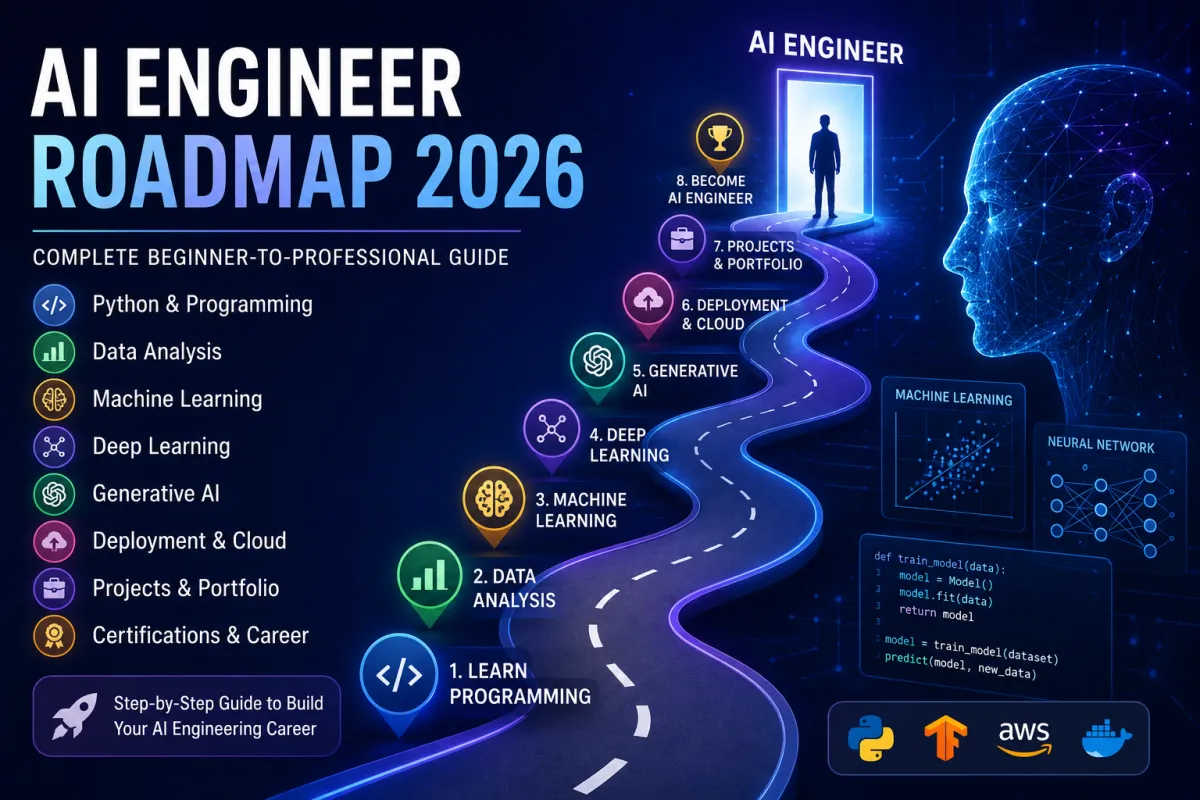
AI Engineer Roadmap 2026: Complete Beginner-to-Professional Guide
Artificial Intelligence is transforming industries across the world. From healthcare and finance to education and manufacturing, organizations are increasingly adopting AI-powered solutions to improve efficiency, automate processes, and unlock new opportunities.
As a result, AI Engineers have become one of the most sought-after professionals in the technology industry. According to industry reports, demand for AI and Machine Learning professionals continues to grow rapidly, making AI Engineering an attractive career path for students, graduates, and working professionals.
If you're wondering how to become an AI Engineer in 2026, this roadmap will guide you through the skills, tools, technologies, projects, certifications, and learning resources needed to build a successful career.
What Does an AI Engineer Do?
An AI Engineer designs, develops, deploys, and maintains artificial intelligence systems.
Typical responsibilities include:
Building machine learning models
Developing AI-powered applications
Working with Large Language Models (LLMs)
Creating recommendation systems
Designing intelligent chatbots
Automating business processes
Deploying AI solutions to production environments
Monitoring model performance
AI Engineers combine software development, machine learning, data science, and cloud computing skills.
AI Engineer Career Path
A typical AI Engineer journey looks like:
Beginner
↓
Programming Foundations
↓
Data Analysis
↓
Machine Learning
↓
Deep Learning
↓
Generative AI
↓
Projects & Portfolio
↓
Cloud Deployment
↓
AI Engineer
↓
Senior AI Engineer / AI Architect
Stage 1: Learn Python Programming
Python is the most widely used programming language in AI.
Focus on:
Variables
Data Types
Functions
Loops
Lists
Dictionaries
Object-Oriented Programming
File Handling
Error Handling
Recommended Tools:
Python
Jupyter Notebook
VS Code
Google Colab
Projects:
Calculator
To-Do Application
Weather Application
Data Analysis Scripts
Stage 2: Master Mathematics for AI
AI relies heavily on mathematics.
Important topics include:
Linear Algebra
Vectors
Matrices
Matrix Operations
Statistics
Mean
Median
Variance
Standard Deviation
Probability
Probability Distributions
Conditional Probability
Bayes Theorem
Calculus
Derivatives
Gradients
Optimization
You do not need advanced mathematics initially, but understanding the fundamentals is important.
Stage 3: Learn Data Analysis
AI models depend on data.
Learn:
Data Cleaning
Data Transformation
Data Visualization
Exploratory Data Analysis (EDA)
Important Libraries:
NumPy
Pandas
Matplotlib
Seaborn
Projects:
Sales Dashboard
Student Performance Analysis
Customer Analytics Dashboard
Stage 4: Learn Machine Learning
Machine Learning is the foundation of AI Engineering.
Topics:
Supervised Learning
Linear Regression
Logistic Regression
Decision Trees
Random Forest
Unsupervised Learning
K-Means Clustering
PCA
Model Evaluation
Accuracy
Precision
Recall
F1 Score
Tools:
Scikit-Learn
Pandas
NumPy
Projects:
House Price Prediction
Customer Churn Prediction
Loan Approval Prediction
Movie Recommendation System
Stage 5: Learn Deep Learning
Deep Learning powers modern AI applications.
Topics:
Artificial Neural Networks
Convolutional Neural Networks (CNNs)
Recurrent Neural Networks (RNNs)
Transformers
Attention Mechanisms
Frameworks:
TensorFlow
Keras
PyTorch
Projects:
Image Classification
Handwritten Digit Recognition
Face Detection System
Object Detection System
Stage 6: Learn Generative AI
Generative AI is one of the fastest-growing areas in technology.
Learn:
Large Language Models (LLMs)
Prompt Engineering
Retrieval-Augmented Generation (RAG)
Vector Databases
AI Agents
Tools:
OpenAI API
LangChain
LlamaIndex
Hugging Face
Pinecone
ChromaDB
Projects:
AI Resume Builder
AI Career Coach
AI Study Assistant
Document Question Answering System
Stage 7: Learn AI Deployment
Building a model is only part of the job.
AI Engineers must deploy solutions.
Learn:
REST APIs
FastAPI
Flask
Docker
GitHub
CI/CD Pipelines
Cloud Platforms:
AWS
Azure
Google Cloud
Projects:
Deploy ChatGPT Applications
AI Web Applications
Real-Time Prediction Systems
Stage 8: Build an AI Portfolio
Your portfolio is more important than certificates alone.
Include:
Beginner Projects
Chatbot
Resume Analyzer
Text Summarizer
Intermediate Projects
Recommendation System
AI Content Generator
Sentiment Analysis System
Advanced Projects
AI Interview Assistant
RAG Application
Multi-Agent AI System
AI Business Automation Platform
Stage 9: Earn Industry Certifications
Certifications help validate your skills.
Recommended options:
Google AI Certifications
Microsoft AI Certifications
AWS Machine Learning Certifications
IBM AI Certifications
DeepLearning.AI Programs
Use certifications to complement projects, not replace them.
Stage 10: Prepare for AI Engineer Interviews
Focus on:
Technical Skills
Python
Machine Learning
Deep Learning
SQL
AI Concepts
Practical Skills
Problem Solving
Project Design
Model Deployment
Portfolio Presentation
Be prepared to explain:
Project goals
Dataset selection
Model choices
Challenges faced
Results achieved
Future Trends in AI Engineering
By 2026 and beyond, AI Engineers should also explore:
AI Agents
Agentic Workflows
Autonomous Systems
AI Automation
Robotics Integration
Multimodal AI
Edge AI
Responsible AI
AI Governance
Professionals who combine AI with automation, cloud computing, and business problem-solving will have a significant advantage.
Final Roadmap Summary
Month 1–2
Python
Data Analysis
Month 3–4
Machine Learning
Statistics
Month 5–6
Deep Learning
Month 7–8
Generative AI
Month 9–10
Deployment
Cloud Platforms
Month 11–12
Portfolio Projects
Interview Preparation
Following this roadmap consistently can help you build the skills needed to pursue roles such as AI Engineer, Machine Learning Engineer, Generative AI Developer, AI Solutions Architect, or AI Product Engineer.
The future belongs to professionals who can combine technical expertise, practical project experience, and continuous learning. Start building today, and your AI career journey can begin sooner than you think.


Facebook
Instagram
X
LinkedIn
Youtube
WhatsApp