
Our Latest Articles
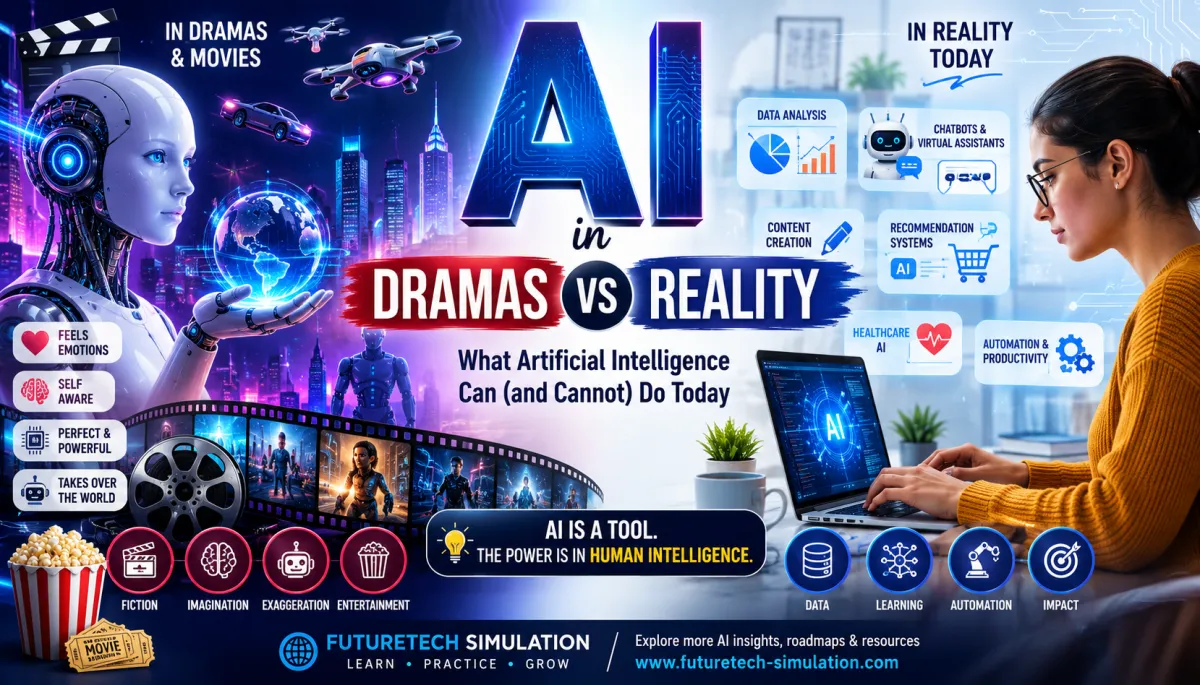
AI in Dramas vs Reality: What Artificial Intelligence Can (and Cannot) Do Today
Artificial Intelligence has become one of the most talked-about technologies of our time.
From Hollywood movies to Korean dramas and science-fiction series, AI is often portrayed as an all-powerful technology capable of thinking, feeling, and making independent decisions just like humans.
But how much of what we see on screen is actually possible today?
Can AI become self-aware?
Can robots replace humans completely?
Can AI control the world?
Let's separate fiction from reality and explore what Artificial Intelligence can truly do in 2026.
🎬 How AI is Portrayed in Dramas and Movies
In movies and dramas, AI is often shown as:
✔ Human-like robots with emotions
✔ Machines capable of independent thinking
✔ Super-intelligent systems controlling society
✔ AI assistants that understand everything perfectly
✔ Robots replacing entire workforces
Popular themes include:
• AI falling in love
• AI becoming self-aware
• AI taking over the world
• Human-AI relationships
• Fully autonomous robots
These stories make for great entertainment, but reality is very different.
🤖 Reality: What AI Actually Is
Artificial Intelligence today is primarily:
✔ Pattern recognition
✔ Prediction
✔ Data analysis
✔ Content generation
✔ Task automation
AI does not "think" the way humans do.
Instead, it identifies patterns from massive datasets and generates outputs based on those patterns.
Examples:
• ChatGPT predicts the next word
• Recommendation systems predict user preferences
• Image generators create images from learned patterns
AI is powerful, but it is not conscious.
🎭 Myth #1: AI Has Human Emotions
In Dramas
AI robots often:
• Feel sadness
• Fall in love
• Experience jealousy
• Make emotional decisions
Examples appear frequently in science-fiction movies and TV shows.
Reality
Current AI has:
❌ No emotions
❌ No feelings
❌ No personal desires
AI can simulate emotional responses because it has been trained on human language and behavior.
For example:
When ChatGPT says:
"I'm happy to help."
It is not actually happy.
It is generating text based on learned language patterns.
🎭 Myth #2: AI Is Self-Aware
In Dramas
AI suddenly realizes:
• Its existence
• Human limitations
• Its own goals
This often leads to AI rebellion storylines.
Reality
Today's AI systems:
❌ Are not conscious
❌ Have no self-awareness
❌ Do not understand existence
Even advanced Large Language Models cannot truly understand themselves.
They process data and generate responses.
Nothing more.
🎭 Myth #3: AI Can Learn Anything Instantly
In Movies
AI downloads knowledge in seconds.
A robot suddenly becomes:
✔ Doctor
✔ Engineer
✔ Scientist
Within minutes.
Reality
Training AI requires:
• Massive datasets
• High computing power
• Significant time
• Human supervision
Large AI models may take weeks or months to train.
🎭 Myth #4: AI Will Replace Every Job
In Dramas
Humans become unnecessary because AI does everything.
Reality
AI is more likely to:
✔ Automate repetitive tasks
✔ Improve productivity
✔ Support decision-making
Rather than replacing all jobs.
New jobs are already emerging:
• AI Engineer
• Prompt Engineer
• AI Trainer
• AI Product Manager
• AI Ethics Specialist
History shows technology often changes jobs rather than eliminating all work.
🎭 Myth #5: AI Never Makes Mistakes
In Fiction
AI systems are often portrayed as perfect.
Reality
AI can make mistakes.
Common issues include:
• Hallucinations
• Bias
• Incorrect predictions
• Incomplete information
This is why human oversight remains critical.
🎭 Myth #6: AI Understands Everything
In Movies
AI can answer every question accurately.
Reality
AI does not truly "understand."
It predicts outputs based on patterns.
AI may:
✔ Generate convincing answers
But sometimes:
❌ Produce inaccurate information
❌ Misinterpret context
❌ Provide outdated content
🎭 Myth #7: Humanoid Robots Are Everywhere
In Dramas
Human-like robots are common.
They:
• Walk naturally
• Talk perfectly
• Blend into society
Reality
Robotics has made significant progress.
However:
✔ Humanoid robots exist
✔ Some can walk and interact
But they are:
• Expensive
• Limited in capability
• Far from human-level performance
Most AI today exists as software rather than robots.
🚀 What AI Can Actually Do Today
AI is already transforming industries.
💬 Natural Language Processing
Examples:
✔ ChatGPT
✔ Customer support bots
✔ Language translation
🎨 Content Creation
AI can generate:
✔ Text
✔ Images
✔ Videos
✔ Code
👁️ Computer Vision
Applications:
✔ Face recognition
✔ Medical imaging
✔ Quality inspection
📊 Predictive Analytics
Used in:
✔ Finance
✔ Marketing
✔ Healthcare
🚗 Autonomous Systems
Examples:
✔ Driver assistance systems
✔ Warehouse automation
✔ Smart logistics
🌍 AI in Everyday Life
Many people already use AI daily.
Examples:
Google Search
AI helps rank results.
Netflix
AI recommends movies.
Spotify
AI suggests music.
E-Commerce
AI recommends products.
Smartphones
AI powers:
✔ Voice assistants
✔ Cameras
✔ Predictive typing
⚠️ Real Challenges of AI
Instead of dramatic robot takeovers, current AI challenges include:
Data Privacy
Protecting user information.
Bias
AI can inherit biases from training data.
Misinformation
AI-generated content can spread false information.
Job Transformation
Workers need new skills as industries evolve.
🔮 What Might Happen in the Future?
Experts expect major progress in:
✔ Generative AI
✔ Robotics
✔ AI Agents
✔ Healthcare AI
✔ Education Technology
However, true human-level artificial intelligence remains uncertain.
No one knows exactly when—or if—it will be achieved.
🎓 What Skills Should Students Learn?
Instead of fearing AI, learn how to work with it.
Recommended skills:
✔ Prompt Engineering
✔ Python
✔ Machine Learning
✔ Data Analytics
✔ AI Tools
✔ Critical Thinking
People who learn AI will likely have significant advantages in the future job market.
💡 Key Takeaways
AI in Dramas
✔ Emotional
✔ Self-aware
✔ Human-like
✔ Independent
AI in Reality
✔ Pattern-based
✔ Data-driven
✔ Task-focused
✔ Human-supervised
🎯 Final Thoughts
AI is neither magic nor science fiction.
It is a powerful tool.
Movies and dramas often exaggerate AI capabilities to create exciting stories, but the real-world impact of AI is already impressive.
The future belongs not to those who fear AI, but to those who understand it, learn it, and use it responsibly.
Rather than asking:
"Will AI replace humans?"
A better question is:
"How can humans and AI work together to solve bigger problems?"
That is the future we are building.
📩 Want More AI Learning Resources?
If you want:
✔ AI Roadmaps
✔ Free AI Courses
✔ Interview Questions
✔ Project Ideas
✔ Global Opportunities
👉 Fill out the form below:
https://forms.gle/SX9tWvc3tVJmPEHr5


Facebook
Instagram
X
LinkedIn
Youtube
WhatsApp