
Our Latest Articles
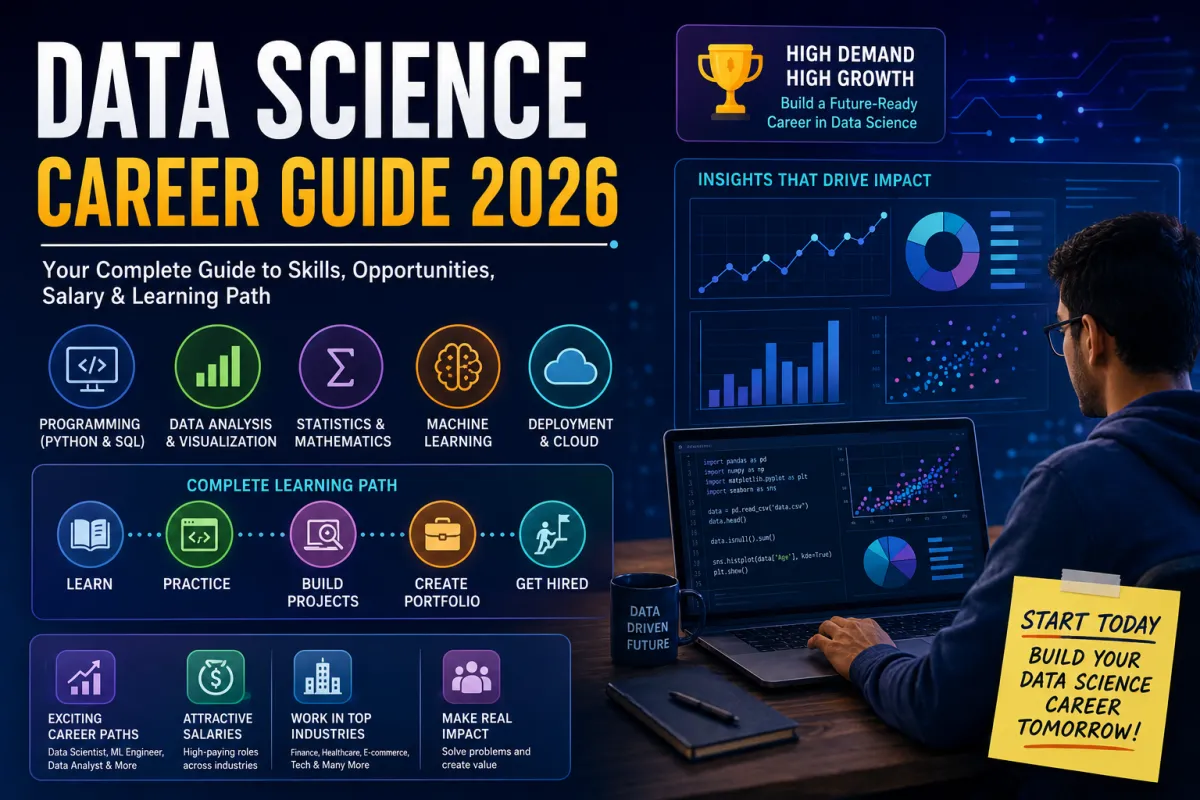
Data Science Career Guide 2026: Skills, Opportunities, Salary & Learning Path
If someone asked you to identify one technology career that combines problem-solving, business impact, analytics, Artificial Intelligence, and future growth, Data Science would be near the top of the list.
Organizations today generate massive amounts of data every second. However, data alone has little value unless someone can transform it into meaningful insights and business decisions.
This is where Data Scientists come in.
From predicting customer behavior to detecting fraud, optimizing supply chains, and building intelligent systems, Data Scientists play a crucial role in modern organizations.
If you're a student, graduate, or working professional wondering whether Data Science is the right career for you, this guide will help you understand the opportunities, skills, challenges, and learning journey ahead.
Why Data Science Is One of the Best Careers Today
Imagine a retail company trying to understand why sales are dropping.
Or a hospital attempting to predict patient risks.
Or a streaming platform recommending your next favorite movie.
Behind all these decisions is data.
Data Science helps organizations:
Make smarter decisions
Reduce risks
Improve customer experiences
Discover hidden opportunities
Predict future outcomes
As businesses become increasingly data-driven, the demand for professionals who can work with data continues to grow.
What Does a Data Scientist Actually Do?
Many beginners assume Data Scientists spend all day building AI models.
In reality, the role is much broader.
A Data Scientist typically:
Collects Data
Gathering information from databases, applications, and business systems.
Cleans Data
Removing errors, inconsistencies, and missing values.
Analyzes Data
Identifying patterns and trends.
Builds Models
Using Machine Learning to make predictions.
Communicates Insights
Helping stakeholders make informed decisions.
Deploys Solutions
Implementing models into production systems.
In simple terms:
A Data Scientist helps organizations make better decisions using data.
A Day in the Life of a Data Scientist
A typical workday may involve:
Morning
Review business requirements.
Meet with stakeholders.
Understand project objectives.
Afternoon
Analyze datasets.
Create visualizations.
Build machine learning models.
Evening
Validate results.
Prepare reports.
Present insights to teams.
Contrary to popular belief, Data Science is not only about coding.
Communication and business understanding are equally important.
Skills Every Data Scientist Needs
Think of Data Science as a combination of four major skill areas.
1. Programming
The most common language is Python.
Key topics include:
Variables
Functions
Data Structures
Object-Oriented Programming
Popular tools:
Python
Jupyter Notebook
VS Code
2. Statistics
Statistics helps transform raw data into meaningful insights.
Important concepts:
Mean
Median
Variance
Standard Deviation
Probability
Hypothesis Testing
A strong statistical foundation separates good analysts from exceptional Data Scientists.
3. Data Analysis
Before building models, you must understand your data.
Skills include:
Data Cleaning
Exploratory Data Analysis
Pattern Recognition
Feature Engineering
Libraries:
Pandas
NumPy
4. Machine Learning
Machine Learning allows systems to learn from data.
Common techniques:
Regression
Classification
Clustering
Recommendation Systems
Tools:
Scikit-Learn
TensorFlow
PyTorch
Tools You'll Use Every Day
A modern Data Scientist works with multiple tools.
Programming
Python
SQL
Visualization
Tableau
Power BI
Matplotlib
Machine Learning
Scikit-Learn
TensorFlow
PyTorch
Collaboration
Git
GitHub
Cloud Platforms
AWS
Microsoft Azure
Google Cloud
The goal isn't mastering every tool immediately.
Focus on fundamentals first.
Data Science Career Paths
One of the biggest advantages of Data Science is flexibility.
Data Analyst
Focus on reporting and dashboards.
Business Analyst
Connect business challenges with data-driven solutions.
Data Scientist
Build predictive and analytical models.
Machine Learning Engineer
Deploy intelligent applications and AI systems.
Data Engineer
Design data pipelines and infrastructure.
Analytics Consultant
Help organizations improve performance through data.
As your skills grow, you can move across these roles.
Industries Hiring Data Scientists
Data Science is valuable in nearly every sector.
Healthcare
Disease prediction.
Patient analytics.
Medical research.
Banking & Finance
Risk assessment.
Fraud detection.
Investment analytics.
Retail
Customer insights.
Demand forecasting.
Inventory optimization.
Manufacturing
Predictive maintenance.
Quality control.
Operational efficiency.
Technology
AI products.
Recommendation systems.
User analytics.
The opportunities are virtually unlimited.
Beginner Mistakes to Avoid
Learning Too Many Tools
Focus on core skills before exploring advanced platforms.
Ignoring SQL
SQL remains one of the most important skills in Data Science.
Avoiding Statistics
Machine Learning becomes much easier when statistical concepts are understood.
Taking Courses Without Projects
Knowledge becomes valuable only when applied.
Not Building a Portfolio
Projects demonstrate capabilities better than certificates.
Building Your Data Science Portfolio
A strong portfolio can significantly improve your career prospects.
Beginner Projects
Student Performance Analysis
Sales Dashboard
Expense Tracker Analytics
Intermediate Projects
Customer Churn Prediction
House Price Prediction
Fraud Detection
Advanced Projects
Recommendation Engine
Real-Time Analytics Dashboard
AI-Powered Business Intelligence Platform
Portfolio platforms:
GitHub
Personal Website
LinkedIn
Every project should clearly demonstrate problem-solving skills.
Your First 90 Days in Data Science
Instead of trying to learn everything at once, focus on progression.
Days 1–30
Learn:
Python
SQL Basics
Data Manipulation
Build:
Simple Analysis Projects
Days 31–60
Learn:
Statistics
Data Visualization
Build:
Dashboards
Business Reports
Days 61–90
Learn:
Machine Learning Fundamentals
Build:
Prediction Models
Classification Projects
By the end of 90 days, you should have multiple projects showcasing your skills.
The Future of Data Science
Data Science continues to evolve rapidly.
Emerging trends include:
Generative AI
Automated Machine Learning
Real-Time Analytics
Explainable AI
Responsible AI
AI-Augmented Data Analysis
Professionals who combine Data Science with AI, cloud technologies, and business understanding will be especially valuable.
Final Thoughts
Data Science is not just about algorithms and dashboards.
It is about solving real-world problems using data.
The most successful Data Scientists focus on three things:
✔ Strong fundamentals
✔ Real-world projects
✔ Continuous learning
Start with Python, learn SQL, understand statistics, build projects, and create a portfolio that demonstrates your abilities.
Your first project matters more than your tenth course.
The journey may seem challenging, but every expert Data Scientist once started with their first dataset.
The best time to begin is today.


Facebook
Instagram
X
LinkedIn
Youtube
WhatsApp