
Our Latest Articles
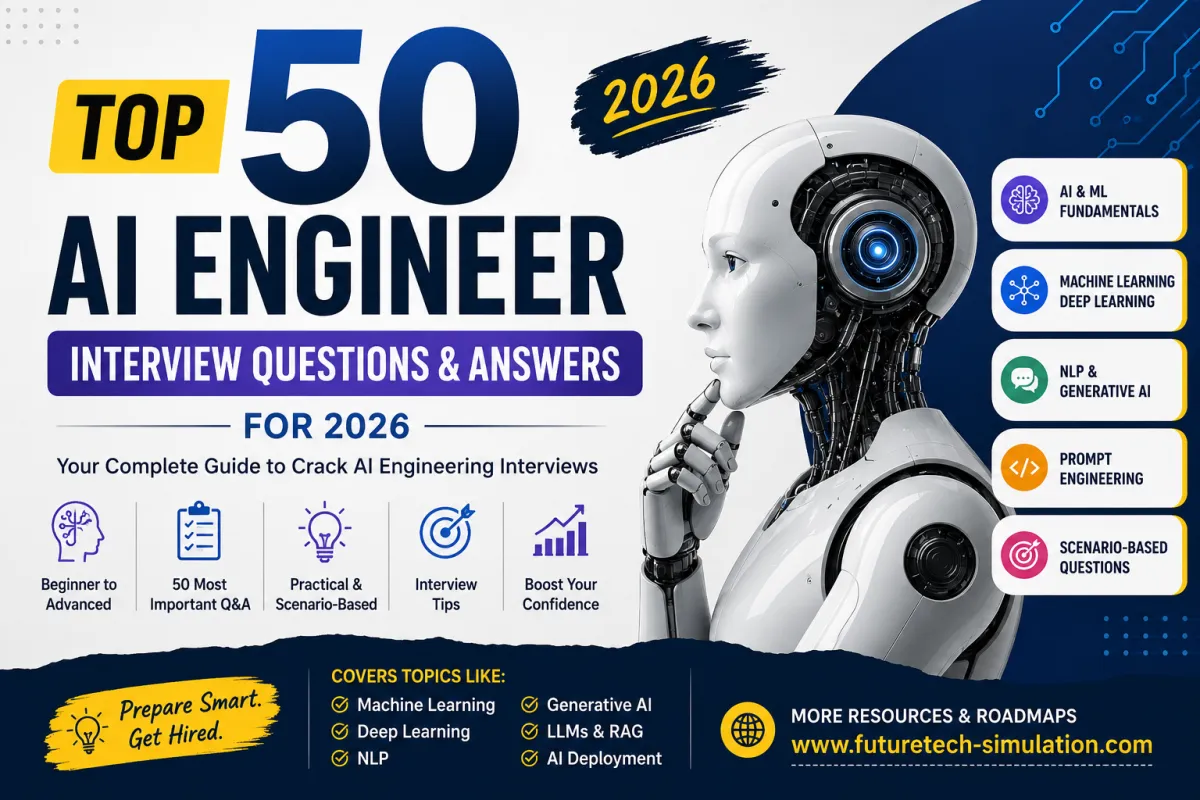
Top 50 AI Engineer Interview Questions and Answers (2026)
Artificial Intelligence is one of the fastest-growing fields in technology today.
Organizations worldwide are hiring AI Engineers to build intelligent systems, automate processes, develop AI applications, and leverage Generative AI technologies.
If you're preparing for an AI Engineer interview, this guide covers the most frequently asked interview questions along with beginner-friendly answers.
🚀 AI Fundamentals Questions
1. What is Artificial Intelligence?
Answer:
Artificial Intelligence (AI) is the simulation of human intelligence in machines that can perform tasks such as learning, reasoning, problem-solving, and decision-making.
2. What are the main types of AI?
Answer:
• Narrow AI (Weak AI)
• General AI (Strong AI)
• Super AI (Theoretical)
Most current applications use Narrow AI.
3. What is Machine Learning?
Answer:
Machine Learning is a subset of AI that enables systems to learn patterns from data and improve performance without explicit programming.
4. What is Deep Learning?
Answer:
Deep Learning is a subset of Machine Learning that uses neural networks with multiple layers to process complex data.
5. What is Generative AI?
Answer:
Generative AI creates new content such as text, images, code, audio, and videos based on learned patterns from training data.
Examples:
• ChatGPT
• Gemini
• Claude
📊 Machine Learning Questions
6. What is supervised learning?
Answer:
A machine learning technique where the model is trained using labeled data.
Examples:
• House price prediction
• Spam classification
7. What is unsupervised learning?
Answer:
A technique where the model identifies patterns in unlabeled data.
Examples:
• Customer segmentation
• Clustering
8. What is reinforcement learning?
Answer:
A learning approach where an agent learns by interacting with an environment and receiving rewards or penalties.
9. What is overfitting?
Answer:
Overfitting occurs when a model performs well on training data but poorly on unseen data.
10. How can overfitting be reduced?
Answer:
• More training data
• Regularization
• Cross-validation
• Simpler models
• Dropout techniques
11. What is underfitting?
Answer:
Underfitting occurs when a model cannot capture patterns in the data.
12. What is a training dataset?
Answer:
The data used to train a machine learning model.
13. What is a test dataset?
Answer:
The dataset used to evaluate model performance on unseen data.
14. What is feature engineering?
Answer:
The process of selecting, modifying, and creating input variables that improve model performance.
15. What is cross-validation?
Answer:
A technique used to evaluate model performance by dividing data into multiple training and validation sets.
📈 Model Evaluation Questions
16. What is Accuracy?
Answer:
The percentage of correct predictions made by the model.
17. What is Precision?
Answer:
Precision measures how many predicted positive results are actually positive.
18. What is Recall?
Answer:
Recall measures how many actual positive cases are correctly identified.
19. What is F1 Score?
Answer:
The harmonic mean of Precision and Recall.
20. What is a Confusion Matrix?
Answer:
A table used to evaluate classification model performance.
🧠 Deep Learning Questions
21. What is a Neural Network?
Answer:
A computational model inspired by the human brain consisting of interconnected neurons.
22. What are hidden layers?
Answer:
Layers between input and output layers where data processing occurs.
23. What is an activation function?
Answer:
A mathematical function that determines whether a neuron should be activated.
Examples:
• ReLU
• Sigmoid
• Tanh
24. What is backpropagation?
Answer:
A process used to update neural network weights based on prediction errors.
25. What is TensorFlow?
Answer:
An open-source deep learning framework developed by Google.
26. What is PyTorch?
Answer:
An open-source machine learning framework widely used for AI research and development.
💬 NLP Questions
27. What is NLP?
Answer:
Natural Language Processing enables computers to understand and process human language.
28. What is tokenization?
Answer:
Breaking text into smaller units called tokens.
29. What are stopwords?
Answer:
Common words such as "is", "the", and "and" that are often removed during text processing.
30. What is stemming?
Answer:
Reducing words to their root form.
Example:
Running → Run
31. What is TF-IDF?
Answer:
A technique used to measure the importance of words within documents.
32. What is sentiment analysis?
Answer:
The process of determining whether text expresses positive, negative, or neutral sentiment.
🤖 Generative AI Questions
33. What is an LLM?
Answer:
A Large Language Model trained on massive amounts of text data.
Examples:
• GPT
• Gemini
• Claude
34. What are tokens in LLMs?
Answer:
Small chunks of text processed by language models.
35. What is Prompt Engineering?
Answer:
The process of designing effective prompts to obtain accurate AI outputs.
36. What is RAG?
Answer:
Retrieval-Augmented Generation combines external knowledge retrieval with language model generation.
37. What is Fine-Tuning?
Answer:
Additional training of a pre-trained model on custom datasets.
38. What are AI Agents?
Answer:
Autonomous systems capable of planning, reasoning, and executing tasks.
⚙️ AI Deployment Questions
39. Why is model deployment important?
Answer:
Deployment allows users to access AI models in real-world applications.
40. What is an API?
Answer:
An interface that allows software systems to communicate with each other.
41. What is Docker?
Answer:
A platform used to package and deploy applications in containers.
42. What is MLOps?
Answer:
Practices that combine Machine Learning, DevOps, and automation for managing AI models.
🎯 Scenario-Based AI Interview Questions
43. How would you handle missing data?
Answer:
• Remove records
• Fill with mean/median
• Use predictive techniques
44. How would you improve model performance?
Answer:
• Feature engineering
• Hyperparameter tuning
• More training data
• Better algorithms
45. How would you detect fraud using AI?
Answer:
Train anomaly detection or classification models using historical transaction data.
46. How would you build a chatbot?
Answer:
Use:
• NLP
• LLMs
• Prompt engineering
• APIs
47. How would you evaluate an AI model?
Answer:
Use metrics such as:
• Accuracy
• Precision
• Recall
• F1 Score
💻 Coding & Practical Questions
48. Which programming language is most used in AI?
Answer:
Python.
49. Which Python libraries are commonly used in AI?
Answer:
• NumPy
• Pandas
• Scikit-learn
• TensorFlow
• PyTorch
50. What AI project have you built?
Answer:
Discuss your project clearly:
• Problem statement
• Dataset
• Model used
• Results achieved
• Challenges faced
🚀 AI Interview Preparation Tips
✔ Understand fundamentals first
✔ Build real projects
✔ Learn Generative AI concepts
✔ Practice scenario-based questions
✔ Create a GitHub portfolio
✔ Share learning on LinkedIn
💡 Final Thoughts
AI interviews are increasingly focused on:
✔ Machine Learning
✔ Generative AI
✔ Problem-solving
✔ Project experience
✔ Practical implementation
The best way to prepare is to combine theory with hands-on projects.
📩 Want More AI Resources?
If you want:
✔ AI Roadmaps
✔ Interview Questions
✔ Project Ideas
✔ Free AI Courses
✔ Internship Opportunities
👉 Fill the form below:
https://forms.gle/SX9tWvc3tVJmPEHr5
🔖 Keywords
AI Engineer Interview Questions, Generative AI Interview Questions, Machine Learning Interview Questions, AI Interview Preparation, Deep Learning Interview Questions, NLP Interview Questions, Prompt Engineering Interview Questions
#️⃣ Hashtags
#AIEngineer #ArtificialIntelligence #MachineLearning #GenerativeAI #DeepLearning #NLP #CareerGrowth #InterviewPreparation #TechCareers #FutureOfWork


Facebook
Instagram
X
LinkedIn
Youtube
WhatsApp