
Our Latest Articles
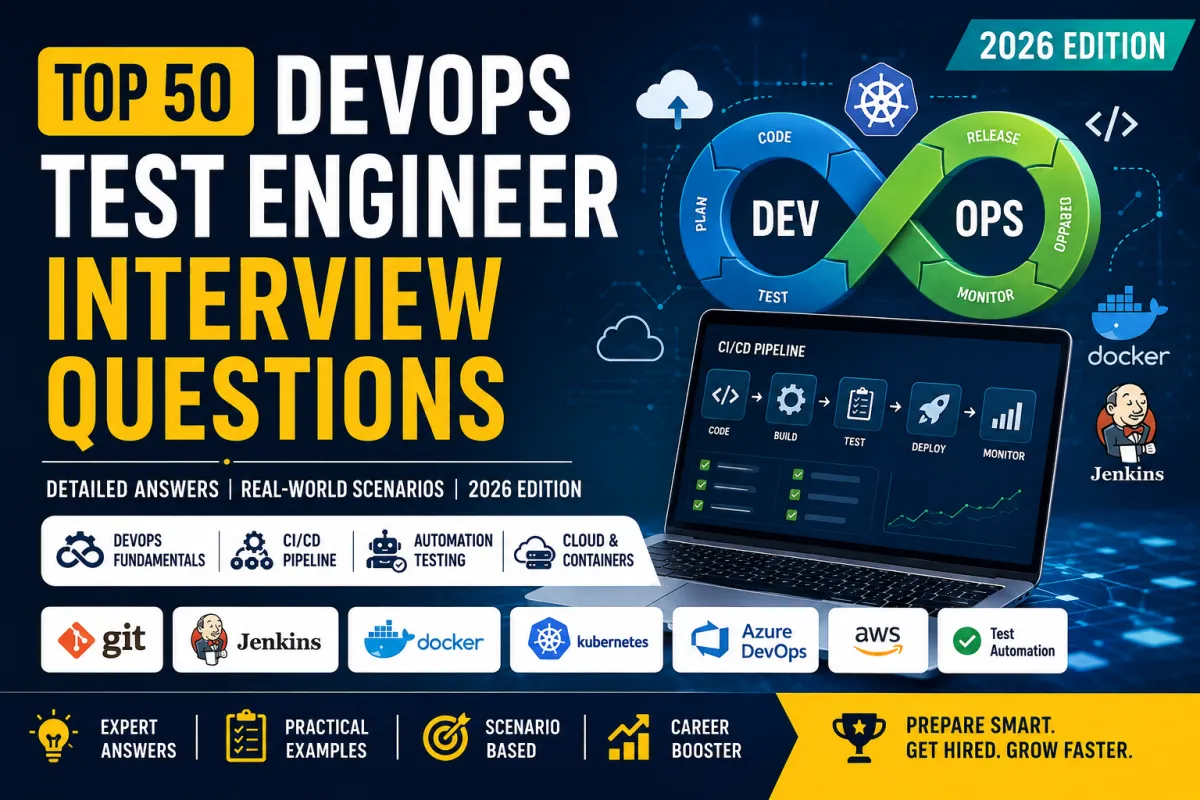
Top 50 DevOps Test Engineer Interview Questions and Answers (2026)
The role of a DevOps Test Engineer combines software testing, automation, CI/CD pipelines, cloud platforms, and infrastructure automation. Organizations expect test engineers to understand not only testing concepts but also deployment pipelines, containerization, cloud services, and continuous testing.
This guide provides 50 frequently asked DevOps Test Engineer interview questions with detailed answers to help you prepare for interviews at product-based companies, startups, and multinational organizations.
Table of Contents
DevOps Fundamentals
Git & Version Control
CI/CD Pipeline
Jenkins
Docker
Kubernetes
Azure DevOps
Automation Testing
Cloud Testing
Scenario-Based Questions
DevOps Fundamentals
1. What is DevOps?
Answer
DevOps is a software development methodology that combines Development (Dev) and Operations (Ops) to improve collaboration, automate workflows, and deliver software faster with higher quality.
Benefits
Faster releases
Improved collaboration
Continuous integration
Continuous delivery
Reduced deployment failures
Faster recovery
Automated testing
2. Explain the DevOps Lifecycle.
Answer
The DevOps lifecycle consists of:
Plan
Develop
Build
Test
Release
Deploy
Operate
Monitor
Feedback
Automation is integrated into every stage.
3. What is Continuous Integration (CI)?
Answer
Continuous Integration is the practice of frequently merging code changes into a shared repository where automated builds and tests are executed.
Benefits include:
Early bug detection
Faster feedback
Reduced integration issues
Improved code quality
4. What is Continuous Delivery?
Continuous Delivery ensures that software is always in a deployable state. Every successful build passes automated testing and is ready for production deployment.
5. What is Continuous Deployment?
Continuous Deployment automatically deploys every successful build to production without manual approval.
Difference:
Continuous DeliveryContinuous DeploymentManual approval requiredFully automated deployment
Git Interview Questions
6. What is Git?
Git is a distributed version control system used to track source code changes.
7. Explain Git Workflow.
Typical workflow:
Developer
↓
Git Clone
 ↓
Create Branch
↓
Code Changes
 ↓
 Git Add
 ↓
Git Commit
↓
Git Push
↓
 Pull Request
 ↓
 Merge
 ↓
CI/CD Pipeline
8. Difference between Merge and Rebase?
Merge combines histories while preserving commits.
Rebase rewrites commit history into a linear sequence.
9. Common Git Commands
git clone
 git branch
git checkout
 git pull
git push
git merge
git rebase
 git stash
git log
10. What is a Pull Request?
A Pull Request allows developers to review and approve code before merging into the main branch.
CI/CD Pipeline Questions
11. Explain a CI/CD Pipeline.
Typical stages:
Developer Commit
↓
Build
 ↓
Static Code Analysis
 ↓
 Unit Testing
 ↓
Automation Testing
↓
Package
 ↓
Docker Image
↓
Deploy
↓
Smoke Test
↓
Production
12. Why automate testing in CI/CD?
Benefits:
Early defect detection
Faster releases
Reduced manual effort
Consistent execution
Immediate feedback
13. What tests should run in CI?
Unit Tests
API Tests
Smoke Tests
Static Analysis
Security Scans
14. What tests should run after deployment?
Smoke Testing
Sanity Testing
API Testing
Regression Testing
Performance Testing
15. How do you reduce pipeline execution time?
Parallel testing
Headless execution
Test tagging
Distributed execution
Incremental builds
Selective regression
Jenkins Interview Questions
16. What is Jenkins?
Jenkins is an open-source automation server used to automate builds, tests, and deployments.
17. Jenkins Pipeline Types
Declarative Pipeline
Scripted Pipeline
18. Sample Jenkins Pipeline
pipeline {
    agent any

    stages {

        stage('Build') {
            steps {
                sh 'npm install'
            }
        }

        stage('Test') {
            steps {
                sh 'npx playwright test'
            }
        }

        stage('Deploy') {
            steps {
                sh './deploy.sh'
            }
        }
    }
}
19. What are Jenkins Agents?
Agents execute jobs assigned by the Jenkins controller, enabling distributed builds.
20. How do you trigger Jenkins jobs?
Git Commit
Webhooks
Scheduled Jobs
Manual Trigger
API Calls
Docker Interview Questions
21. What is Docker?
Docker packages applications with all dependencies into lightweight containers.
22. Docker Components
Docker Engine
Docker Image
Docker Container
Docker Hub
Dockerfile
23. Docker Image vs Container
ImageContainerTemplateRunning instanceRead-onlyExecutable
24. Sample Dockerfile
FROM node:20

WORKDIR /app

COPY . .

RUN npm install

CMD ["npm","test"]
25. Docker Commands
docker build

docker run

docker ps

docker images

docker stop

docker rm

docker logs
Kubernetes Questions
26. What is Kubernetes?
Kubernetes is a container orchestration platform used to deploy, scale, and manage containerized applications.
27. What is a Pod?
A Pod is the smallest deployable unit in Kubernetes and can contain one or more containers that share networking and storage.
28. What is a Deployment?
A Deployment manages ReplicaSets and ensures the desired number of Pods are running, supporting rolling updates and rollbacks.
29. What is a Service in Kubernetes?
A Service exposes Pods using a stable network endpoint, allowing applications to communicate reliably even when Pods are recreated.
30. Difference between Pod and Deployment
PodDeploymentSingle instanceManages multiple PodsTemporarySelf-healing & scalable
Azure DevOps Questions
31. What is Azure DevOps?
Azure DevOps provides services for source control, CI/CD pipelines, boards, test plans, artifacts, and repositories.
32. Azure DevOps Services
Azure Repos
Azure Pipelines
Azure Boards
Azure Test Plans
Azure Artifacts
33. YAML Pipeline Example
trigger:
- main

pool:
  vmImage: ubuntu-latest

steps:
- script: npm install
- script: npx playwright test
34. What are Build Pipelines?
Build pipelines compile code, run automated tests, generate artifacts, and validate quality before deployment.
35. Release Pipeline vs YAML Pipeline
Release pipelines traditionally separate deployment stages, while YAML pipelines define build and deployment as code within the repository.
Automation Testing Questions
36. How do you integrate Playwright with CI/CD?
Store code in Git
Trigger pipeline on commit
Install dependencies
Execute Playwright tests
Publish reports
Notify team
37. Why is Playwright suitable for DevOps?
Fast execution
Cross-browser support
Parallel execution
Headless mode
HTML reports
CI/CD integration
38. How do you manage test data in pipelines?
Configuration files
Environment variables
Secure secrets
Mock services
Test databases
39. How do you handle flaky tests?
Improve locators
Remove unnecessary waits
Use explicit waits
Retry only when justified
Investigate root causes
40. What metrics should be monitored?
Test pass rate
Build success rate
Deployment frequency
Mean Time to Recovery (MTTR)
Change failure rate
Pipeline duration
Cloud Testing Questions
41. What is cloud testing?
Testing applications hosted on cloud infrastructure across different browsers, devices, operating systems, and regions.
42. Benefits of cloud testing
Scalability
Parallel execution
Cost efficiency
Global availability
Faster feedback
43. Popular cloud platforms
AWS
Microsoft Azure
Google Cloud Platform (GCP)
44. What are Infrastructure as Code (IaC) tools?
Common tools include:
Terraform
AWS CloudFormation
Azure Resource Manager (ARM)
Bicep
45. Why use containers in testing?
Containers provide consistent, isolated environments, reducing "works on my machine" issues.
Scenario-Based Questions
46. A deployment failed after passing all tests. What would you do?
Review deployment logs.
Validate configuration and environment variables.
Check infrastructure health.
Roll back if necessary.
Perform root cause analysis.
Add tests to prevent recurrence.
47. Your CI pipeline suddenly becomes slow. How would you investigate?
Analyze stage durations.
Review recent changes.
Check agent resource utilization.
Optimize test execution with parallelism.
Remove redundant steps.
48. A test passes locally but fails in the pipeline. Why?
Possible causes include:
Environment differences
Timing issues
Missing dependencies
Test data inconsistencies
Network instability
49. How would you secure secrets in a CI/CD pipeline?
Use secret management solutions such as:
Azure Key Vault
GitHub Secrets
Jenkins Credentials
HashiCorp Vault
Never hardcode credentials in source code.
50. Describe your DevOps testing workflow.
A strong answer might include:
Develop feature on a Git branch.
Commit and push code.
Trigger CI pipeline.
Run unit, API, and UI tests.
Build Docker image.
Deploy to staging.
Execute smoke and regression tests.
Monitor logs and metrics.
Deploy to production after approvals.
Continuously monitor and improve.


Facebook
Instagram
X
LinkedIn
Youtube
WhatsApp