
Our Latest Articles
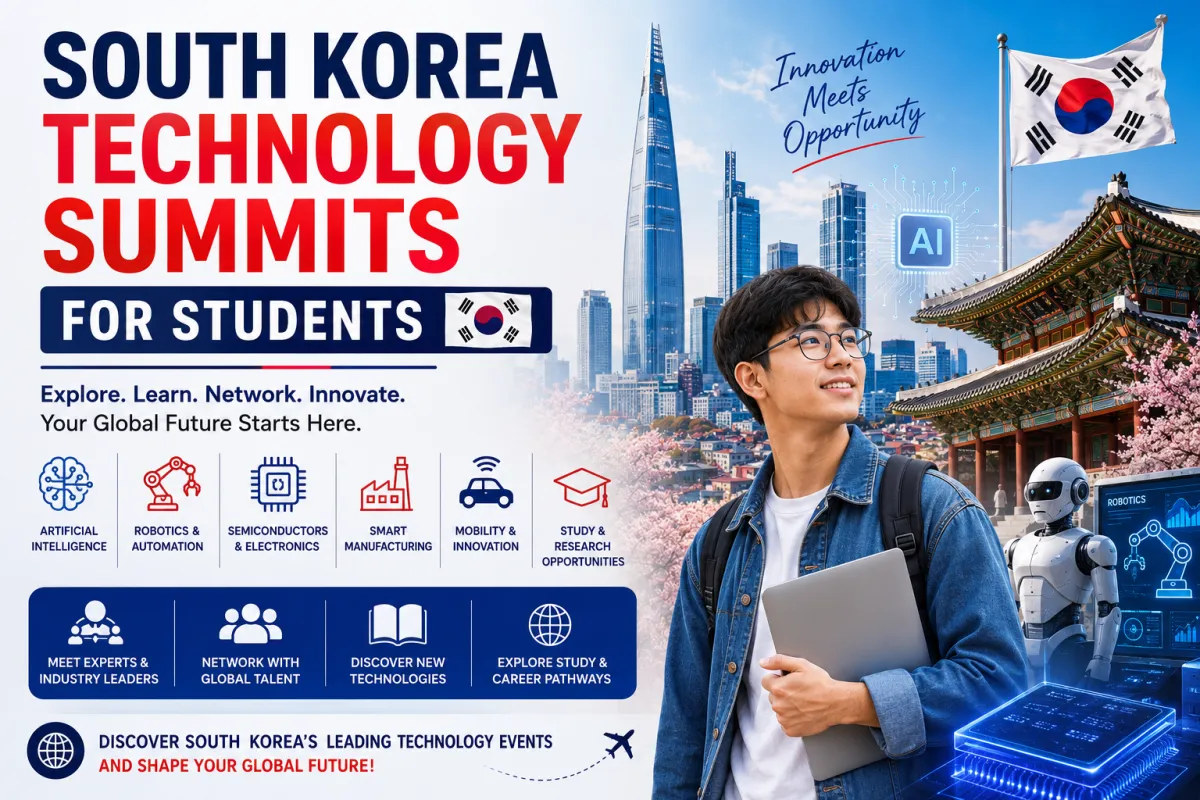
South Korea Technology Summits for Students: A Complete Guide to AI, Robotics, Semiconductors & Global Opportunities
South Korea is one of Asia's most interesting technology ecosystems for students interested in artificial intelligence, robotics, semiconductors, electronics, software, advanced manufacturing, mobility and digital innovation.
For an Indian student, attending a technology summit in South Korea can be an opportunity to do much more than attend presentations.
You can:
Learn about emerging technologies
Understand industry trends
See real technology demonstrations
Meet students and researchers
Interact with companies and universities
Explore higher-education opportunities
Discover research areas
Build international exposure
Improve your professional network
But there is an important difference between attending an event and using an event for your career.
This guide explains how students can approach technology summits and events in South Korea strategically.
1. Why Should Students Consider South Korea?
South Korea has a strong technology ecosystem covering areas such as:
Artificial Intelligence
Robotics
Semiconductors
Electronics
Software
Telecommunications
Smart manufacturing
Mobility
Automation
Digital transformation
Advanced materials
Quantum technology
This makes South Korea particularly interesting for students studying:
Computer Science
Information Technology
Artificial Intelligence
Data Science
Electronics
Electrical Engineering
Mechanical Engineering
Mechatronics
Robotics
Manufacturing
Semiconductor Engineering
The goal isn't to assume that South Korea is automatically the best destination for every student.
Instead, ask:
Does the Korean technology ecosystem match my career interests?
2. What Is a Technology Summit?
A technology summit is generally an event where professionals, researchers, companies, universities and other participants come together around a particular technology or industry.
Depending on the event, you may find:
Keynote presentations
Experts discuss major developments and future trends.
Technical sessions
Speakers explain technologies and applications in more depth.
Exhibitions
Companies demonstrate products and technologies.
Research presentations
Researchers and students present their work.
Panel discussions
Experts discuss industry challenges and future directions.
Networking
Participants interact with researchers, students, companies and other professionals.
Not every event includes all of these, so students should examine the official event program before registering.
3. Technology Events Are Not All the Same
Before choosing an event, understand what you are actually attending.
Technology Conference
Usually more focused on:
Research
Technical presentations
Industry knowledge
Academic discussion
Best for students who want deeper technical exposure.
Technology Exhibition
Usually includes:
Company booths
Product demonstrations
Startups
Technology showcases
Best for students who want to understand how technologies are being applied.
Student Competition
Students may have to:
Build something
Solve a technical problem
Present a project
Participate in a team
Submit research
These can be particularly useful for students who already have practical skills.
University / Education Fair
These events focus more on:
Universities
Courses
Admissions
Scholarships
International student opportunities
The Korean government's Study in Korea platform lists education fairs and provides university and admissions information for international students. In 2026, it says 25 offline Study in Korea fairs are planned, along with online fairs.
4. What Technology Areas Can You Explore?
🤖 Robotics
Students interested in robotics can explore:
Humanoid robots
Autonomous robots
Industrial robots
Service robots
Computer vision
Edge AI
Autonomous systems
Robotics software
For example, the 2026 TechCon conference in Seoul had a dedicated robotics day covering physical AI, humanoid robots, edge AI and autonomous systems.
5. Artificial Intelligence
AI events can cover areas such as:
Generative AI
Machine learning
Multi-agent systems
AI infrastructure
Computer vision
Autonomous AI
AI applications
AI for science
Students should use these events to understand where the technology is heading.
For example, TechCon 2026's AI program focused on the transition from generative AI toward multi-agent systems and autonomous decision-making.
6. Semiconductors
South Korea is particularly relevant for students interested in semiconductor technology.
Students from:
Electronics
Electrical Engineering
Computer Engineering
VLSI
Embedded Systems
Semiconductor Engineering
may find semiconductor conferences and university events especially relevant.
South Korean technology institutions and universities regularly conduct semiconductor-related conferences, workshops and research events.
For example, SeoulTech's 2026 calendar includes semiconductor-related events such as the K-AI Semiconductor Growth Forum and the Korean Conference on Semiconductors.
7. AI + Semiconductors
An increasingly interesting area is the combination of:
AI + Computing + Semiconductors
AI isn't only about software.
Behind AI applications are:
Processors
GPUs
AI accelerators
Memory
Semiconductor design
Advanced packaging
Computing infrastructure
This creates career possibilities for students interested in both hardware and AI.
So an electronics student doesn't necessarily need to move entirely into software to participate in the AI ecosystem.
8. Advanced Manufacturing & Mobility
Students interested in mechanical engineering, manufacturing, automation or robotics should also look for events covering:
Smart factories
Industrial AI
Automation
Digital twins
Autonomous manufacturing
Robotics
Mobility
Intelligent production systems
For example, USTIC 2026 includes Advanced Manufacturing & Mobility as one of its research clusters.
9. Current South Korea Events Students Can Watch
Event schedules change every year, so always verify the current official information.
Here are some useful 2026 examples.
USTIC 2026 — Daejeon
Dates: October 1–2, 2026
Venue: Daejeon Convention Center
Language: English
USTIC 2026 is the Unlimited Science & Technology International Conference, hosted by the University of Science & Technology.
Its theme is:
AI for Science
The program covers areas including:
AI
Quantum information
Advanced robotics
Bio and health
Space and basic science
Energy and environment
Advanced manufacturing
Mobility
The conference also includes oral presentations, poster sessions, expert talks and networking.
This could be particularly interesting for students interested in research and advanced technology.
10. Why USTIC Could Be Interesting for Students
USTIC specifically highlights student research and provides opportunities for students to present and discuss research.
Its 2026 program includes:
90 oral presentations
144 poster presentations
Research cluster sessions
Student research presentations
Networking
Industry talks
The organizers describe it as a platform for international science, technology, innovation and collaboration.
Who might benefit?
Students interested in:
AI research
Robotics
Science & technology
Engineering research
Advanced manufacturing
Mobility
Quantum technology
should investigate the event and its eligibility requirements.
11. TechCon — Seoul
The 2026 TechCon event was held at COEX, Seoul, from June 10–12, 2026.
It covered three major themes:
Day 1
Robotics
Day 2
AI
Day 3
Autonomous Manufacturing
The official event information lists Korean and English as conference languages, with simultaneous interpretation.
For students, this type of event can be useful for understanding the relationship between:
AI → Robotics → Automation → Manufacturing
rather than looking at each technology independently.
12. Maker Faire Seoul
Students who enjoy building things can also look beyond traditional conferences.
The 2026 Maker Faire Seoul is scheduled for September 19–20, 2026 at the DDP Future-ro area.
The Seoul Metropolitan Government describes the event as featuring areas including:
AI
Robotics
Indie games
Entertainment technology
Media art
The event is designed around making, creativity and sharing technology projects.
This type of event can be especially interesting for students who prefer hands-on projects rather than only listening to presentations.
13. Study in Korea Education Fairs
Not every valuable student event is a technology conference.
If your goal is to explore higher education in South Korea, Study in Korea fairs can be more relevant.
The Korean government's Study in Korea platform provides:
University information
Admissions information
Scholarship information
Education fairs
University search
International student resources
The platform says 25 offline Study in Korea fairs are planned for 2026, plus two online fairs.
These are useful for students asking:
"Which Korean universities offer programs related to my career?"
14. How Do I Know Which Event Is Right for Me?
Don't choose an event simply because it is happening in Seoul.
Use this simple test.
If you are an AI student
Look for:
AI
Machine learning
Generative AI
AI infrastructure
Computer vision
Robotics
If you are an Electronics student
Look for:
Semiconductors
VLSI
Embedded systems
AI chips
Electronics
If you are a Mechanical student
Look for:
Robotics
Smart manufacturing
Automation
Mobility
Industrial AI
If you are a Computer Science student
Look for:
AI
Software
Cloud
Cybersecurity
Robotics
Data
If you want to study in Korea
Look for:
University fairs
International student events
University open days
Scholarship events
Academic conferences
15. Check Eligibility Before Registering
This is extremely important.
Not every Korean technology event is open to international students.
Some events may welcome international participants.
Others may be:
Restricted to Korean university students
Intended for researchers
Intended for professionals
Limited to specific academic fields
Invitation-only
Limited by age or education level
For example, a university competition may be specifically restricted to students enrolled at Korean universities.
Therefore:
Always check the official eligibility requirements before booking flights or paying registration fees.
16. What Should You Look for on the Official Website?
Before registering, check:
☐ Event organizer
☐ Official website
☐ Date
☐ Location
☐ Event language
☐ Student eligibility
☐ International participation
☐ Registration deadline
☐ Registration fee
☐ Student discount
☐ Program/agenda
☐ Speakers
☐ Participating organizations
☐ Exhibition details
☐ Cancellation policy
17. Don't Book Your Trip Just Because the Event Looks Interesting
International travel involves more than the event registration fee.
Calculate:
Event fee
Flight
Accommodation
Local transportation
Food
Travel insurance
Entry/immigration requirements
Other expenses
=
Total trip cost
Then ask:
What am I expecting to gain from this trip?
18. How to Decide Whether It Is Worth the Money
Ask yourself five questions.
1. Is this relevant to my career?
If you're studying AI and the event is unrelated to your field, perhaps not.
2. Will I learn something valuable?
Check the agenda.
3. Can I meet useful people?
Look at speakers, universities and participating companies.
4. Can I demonstrate something?
A student with a project can benefit more from certain events than someone attending without preparation.
5. What will I do afterward?
If your answer is simply:
"I will get a certificate."
you should reconsider.
19. Prepare Before the Event
Don't wait until you arrive in Korea.
One month before
Start researching:
Speakers
Companies
Universities
Technologies
Sessions
Identify your top priorities.
20. Prepare Your Resume
Keep your resume concise.
Include:
Education
Your degree and institution.
Skills
Only relevant technical skills.
Projects
Focus on practical work.
Achievements
Hackathons, competitions, research and relevant activities.
Career objective
A clear direction.
21. Prepare Your LinkedIn Profile
Before an international event, make sure your LinkedIn profile is professional.
Include:
Professional headline
Education
Skills
Projects
GitHub
Career interests
For example:
Instead of:
Student
use something more specific such as:
Computer Science Student | AI & Machine Learning | Python | Building AI Projects
provided it accurately represents your experience.
22. Prepare Your GitHub
For technology students, GitHub can be more useful than collecting certificates.
Make sure:
Your repositories are organized
Project names are clear
README files explain the project
Technologies are listed
Screenshots/demos are included where appropriate
You can explain your own code
Your objective should be:
"If someone asks what I can build, I can show them."
23. Prepare a Short Introduction
You don't need a complicated speech.
For example:
"Hi, I'm an engineering student from India. I'm currently interested in AI and robotics, and I'm exploring how these technologies are being used in Korea."
Then ask:
"What area are you currently working in?"
That's enough to start a conversation.
24. What Should You Ask Professionals?
Don't immediately ask:
"Can you give me an internship?"
Instead ask useful questions.
Question 1
"What skills do you think students entering this field should develop?"
Question 2
"What technologies are becoming important in your industry?"
Question 3
"What kind of projects would make a student stand out?"
Question 4
"Do you work with international students or researchers?"
Question 5
"Are there university programs or research opportunities related to this area?"
These questions can produce much more useful conversations.
25. How to Talk to University Representatives
If you meet a Korean university representative, ask:
What programs are available in my field?
Are programs taught in English?
What are the admission requirements?
Are scholarships available?
Are international students eligible?
Are there research opportunities?
What support is available for international students?
Are there exchange or short-term programs?
Then note the official contact details and follow up later.
26. How to Network with Other Students
Don't focus only on professionals.
Other students can become valuable international connections.
Ask:
"What are you studying?"
"Which university are you from?"
"What technology area are you interested in?"
"Are you working on any projects?"
You may discover:
Research groups
Student communities
Hackathons
University events
Exchange opportunities
Collaborative projects
27. Don't Try to Meet Everyone
A common mistake is trying to collect as many contacts as possible.
Instead:
Aim for 5 meaningful conversations.
After each conversation, note:
Name:
Organization:
Area:
What we discussed:
Follow-up needed:
Five useful connections can be more valuable than 100 random contacts.
28. What If You Don't Speak Korean?
Don't automatically assume that you cannot participate.
Some international events provide English programming or participation options.
For example, USTIC 2026 lists English as its conference language.
However, language availability differs by event.
Before registering, check:
Is English available?
If not, determine whether translation is provided.
Learning basic Korean can still make daily interactions easier, but the requirement depends on the event and your objectives.
29. What Should You Do During the Event?
Create a simple plan.
Morning
Attend your highest-priority session.
Afternoon
Visit relevant exhibitions or university/company booths.
Networking
Talk to 2–3 people.
End of day
Write down:
3 things I learned
2 people I met
1 action I will take
This simple system makes the experience much more useful.
30. What Should You Do After the Event?
This is where many students stop.
Don't.
Within a few days:
1. Connect on LinkedIn
Send a short personalized message.
2. Review your notes
Identify the most important ideas.
3. Research companies
Look at organizations you discovered.
4. Research universities
If higher education interests you, investigate relevant programs.
5. Build something
If you learned about a technology that interests you, create a small project.
6. Share your experience
Write a useful LinkedIn post.
31. Turn the Event into a Project
This is an excellent way to convert exposure into evidence.
Suppose you attend a robotics event.
You learn about:
Computer Vision + Robotics
Instead of only posting:
"I attended a robotics conference."
you could build:
A computer-vision-based object detection project
Then document:
Event → Learning → Project → GitHub → Portfolio
Now the event has directly contributed to your career profile.
32. Turn the Event into a Career Story
Imagine an interviewer asks:
"Why are you interested in robotics?"
Instead of saying:
"I like robots."
you can explain:
"I became particularly interested in robotics after attending technology events and learning about autonomous systems and physical AI. I then explored the topic through a practical project..."
That is a much stronger career story.
33. Can a Summit Help You Get an Internship?
It can help, but it does not guarantee one.
A summit can help you:
Discover companies
Understand required skills
Meet people
Learn about opportunities
Improve industry awareness
Build confidence
But you still need:
Skills + Projects + Profile + Application + Interview Preparation
Don't treat a conference as a shortcut around the normal hiring process.
34. Can a Summit Help With Study Abroad?
Potentially, yes.
If you meet university representatives or learn about Korean universities, you may discover:
Degree programs
Research opportunities
Scholarships
Short-term programs
Exchange opportunities
The official Study in Korea platform also provides university search, admission information, scholarship resources and education-fair information.
35. Example: An Indian AI Student
Let's take a practical example.
Student
Final-year Computer Science student from Chennai.
Current skills
Python
Basic Machine Learning
Basic SQL
Projects
Two academic projects.
Goal
AI career.
Step 1
Student identifies an AI-focused event in Korea.
Step 2
Checks:
International eligibility
English availability
Cost
Program
Speakers
Step 3
Prepares:
Resume
LinkedIn
GitHub
Self-introduction
Step 4
Attends AI sessions.
Step 5
Talks to:
Researchers
Students
Companies
Step 6
Learns about:
Generative AI
AI agents
Korean university programs
Step 7
Returns to India.
Step 8
Builds a project related to something learned at the event.
Step 9
Documents the project on GitHub.
Step 10
Uses the experience when preparing for future internships or higher studies.
Now the event has become part of the student's career development journey.
36. A Student's International Event Checklist
Before registering
☐ Is the event legitimate?
☐ Is it relevant to my career?
☐ Am I eligible?
☐ Is international participation allowed?
☐ Is English available?
☐ What is the total cost?
☐ What will I learn?
☐ Who will attend?
Before travelling
☐ Passport
☐ Required travel/entry documentation
☐ Event registration
☐ Accommodation
☐ Travel insurance
☐ Resume
☐ GitHub
☐ Self-introduction
☐ Questions to ask
☐ List of priority sessions
During the event
☐ Attend relevant sessions
☐ Ask questions
☐ Visit relevant booths
☐ Meet students
☐ Meet professionals
☐ Connect appropriately
☐ Take notes
After the event
☐ Follow up with useful contacts
☐ Update LinkedIn
☐ Document learning
☐ Research opportunities
☐ Start a related project
☐ Add meaningful experience to portfolio
☐ Identify your next action
37. Should You Learn Korean Before Attending?
Learning Korean is not automatically required for every event.
The right answer depends on:
Event language
Your goals
Location
Duration
Whether you want long-term opportunities in Korea
If you are only attending an English-language conference, English may be sufficient for the event.
If you want to build a longer-term connection with Korean universities or companies, learning Korean can be a useful additional skill.
The important principle is:
Technology skills come first for a technology career; language skills can strengthen your ability to participate in the local environment.
38. Should You Travel to Korea Just for One Event?
Not necessarily.
If you're already travelling, consider combining the trip with other legitimate academic activities, such as:
University information sessions
University visits
Research seminars
Technology exhibitions
Student networking
Cultural learning
But don't create an unrealistic itinerary.
Give yourself enough time to actually benefit from each activity.
39. What Students Should Avoid
Be careful about:
❌ Unverified event websites
❌ "Guaranteed internship" claims
❌ "Guaranteed job" promises
❌ Paying unofficial agents without verification
❌ Assuming every event accepts international students
❌ Booking flights before confirming participation
❌ Attending only to collect certificates
❌ Sharing sensitive personal documents unnecessarily
❌ Assuming event participation automatically leads to employment
Always verify important information directly with the official organizer.
40. Your Goal Should Be Bigger Than Attending an Event
A successful international technology experience should ideally create a chain:
Learn
↓
Network
↓
Build
↓
Document
↓
Apply
For example:
Attend AI event
↓
Learn about AI agents
↓
Build an AI project
↓
Publish on GitHub
↓
Share learning on LinkedIn
↓
Use project in internship applications
That is how a two-day event can create months of career value.
41. Is South Korea Right for You?
Ask yourself:
Choose to explore Korea if:
You are genuinely interested in Korean technology
Your field matches available events
You want international exposure
You want to explore Korean universities
You are interested in AI, robotics, semiconductors or advanced manufacturing
You have a realistic travel budget
Think carefully if:
You are travelling only because "Korea is popular"
You don't know what you want to learn
You have no plan for using the experience
The event is unrelated to your field
The total cost is too high for the expected benefit
42. Final Advice for Indian Students
You don't need to travel internationally simply to say:
"I attended a technology summit in Korea."
Instead, aim to return with:
3 new things you learned
5 meaningful connections
1 new career insight
1 project idea
1 concrete next step
That is a much stronger outcome.
The most valuable international experience isn't necessarily the event itself.
It is what you do with the experience afterward.
🚀 Want to Explore Global Technology Opportunities?
If you are a student interested in AI, software, robotics, data science, engineering, semiconductors or other emerging technologies, you can begin by understanding your own career direction before deciding which international opportunities are relevant to you.
FutureTech Simulation's Career Awareness & Pre-Assessment helps students start with their education, interests, skills and career goals.
🎓 Register for the FutureTech Career Awareness Program
Complete the registration and career pre-assessment:
FutureTech Career Registration Form
The assessment is a starting point for understanding your current career position and exploring suitable next steps.
Important Note
Event dates, eligibility, registration fees, language arrangements and participation rules can change. Some events are open to international participants, while others may be restricted to particular universities, countries, academic groups or professional categories. Always verify the latest information directly with the official event organizer before paying fees or making travel arrangements.
The examples in this article are intended to help students understand the types of opportunities available; they are not a guarantee that an individual student is eligible to attend.


Facebook
Instagram
X
LinkedIn
Youtube
WhatsApp