
Our Latest Articles
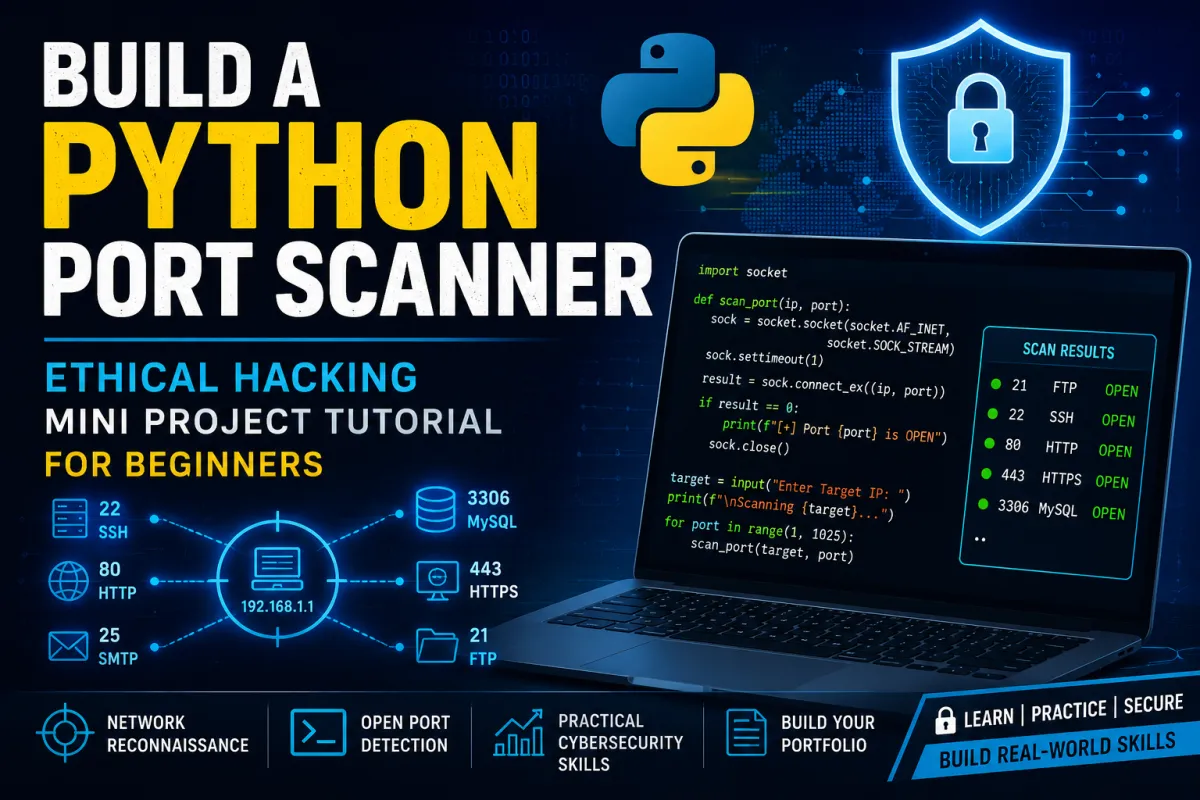
Build a Python Port Scanner: Ethical Hacking Mini Project Tutorial for Beginners
Ethical Hacking Mini Project: Build a Python Port Scanner from Scratch
One of the first skills every aspiring ethical hacker should learn is network reconnaissance. Before security professionals can identify vulnerabilities, they must first understand which systems, services, and ports are exposed on a network.
Port scanning is a fundamental technique used during the reconnaissance phase of ethical hacking and penetration testing. It helps security professionals discover open ports and running services on target systems.
In this hands-on tutorial, you will build a simple Python-based Port Scanner from scratch. This project is beginner-friendly and will help you understand networking concepts, socket programming, and ethical hacking fundamentals.
Important Note: Only scan systems that you own or have explicit permission to test.
What is a Port Scanner?
A port scanner is a tool that checks whether specific network ports on a device are open, closed, or filtered.
Common examples include:
Nmap
Masscan
Angry IP Scanner
By creating your own port scanner, you'll understand how these tools work behind the scenes.
Project Objectives
By completing this project, you will learn:
TCP/IP Networking Basics
Socket Programming
Open Port Detection
Python Fundamentals
Ethical Hacking Reconnaissance Techniques
Prerequisites
Before starting, make sure you have:
Software
Python 3.x
VS Code or any Python IDE
Internet Connection
Knowledge
Basic Python
Basic Networking Concepts
IP Addresses
Ports
Understanding Ports
Ports allow applications to communicate over networks.
Examples:
PortService21FTP22SSH25SMTP53DNS80HTTP443HTTPS
When a port is open, a service is actively listening for connections.
Project Architecture
User Inputs Target IP ↓
Python Scanner ↓
Checks Port Availability ↓
Reports Open Ports
Step 1: Create Project Folder
Create a folder named:
PortScannerProject
Inside it create:
port_scanner.py
Step 2: Import Required Libraries
Open the Python file and add:
import socket
Why Socket?
The socket module allows Python to communicate using network protocols.
Step 3: Get Target IP Address
Add:
target = input("Enter Target IP Address: ")
Example:
192.168.1.1
Step 4: Create Port Scanning Function
Add:
def scan_port(ip, port): try: sock = socket.socket( socket.AF_INET, socket.SOCK_STREAM ) sock.settimeout(1) result = sock.connect_ex((ip, port)) if result == 0: print(f"Port {port} is OPEN") sock.close() except: pass
What Happens Here?
Creates TCP socket
Attempts connection
Checks if connection succeeds
Displays open ports
Step 5: Scan Common Ports
Add:
print(f"Scanning {target}...") for port in range(1, 1025): scan_port(target, port)
This scans ports:
1 → 1024
These are commonly used service ports.
Step 6: Complete Program
Final code:
import socket target = input("Enter Target IP Address: ") def scan_port(ip, port): try: sock = socket.socket( socket.AF_INET, socket.SOCK_STREAM ) sock.settimeout(1) result = sock.connect_ex((ip, port)) if result == 0: print(f"Port {port} is OPEN") sock.close() except: pass print(f"Scanning {target}...") for port in range(1, 1025): scan_port(target, port)
Step 7: Run the Scanner
Execute:
python port_scanner.py
Example:
Enter Target IP Address:
127.0.0.1
Output:
Scanning 127.0.0.1 Port 80 is OPEN
Port 443 is OPEN
Port 3306 is OPEN
Understanding the Results
Open Port
A service is actively listening.
Closed Port
No service is listening.
Filtered Port
Firewall may be blocking access.
Security Applications
Ethical hackers use port scanning to:
Discover exposed services
Identify attack surfaces
Map network infrastructure
Verify firewall configurations
System administrators use it to:
Audit security
Monitor services
Troubleshoot networks
Enhancing the Project
After building the basic scanner, add:
Multi-threading
Scan faster.
Service Detection
Identify running services.
Example:
Port 80 → HTTP
Port 22 → SSH
Banner Grabbing
Retrieve service information.
GUI Interface
Build using Tkinter.
Export Reports
Generate CSV reports.
Real-World Tools Using Similar Concepts
Professional tools built on similar principles include:
Nmap
Zenmap
Masscan
Nessus
OpenVAS
Understanding your own scanner helps you understand these professional tools.
Skills Demonstrated in This Project
Add these to your resume:
Networking
TCP/IP
Ports
Services
Python
Functions
Loops
Error Handling
Cybersecurity
Reconnaissance
Port Scanning
Network Enumeration
Portfolio Documentation
When publishing this project on GitHub, include:
Project Overview
Purpose of the scanner.
Screenshots
Terminal output.
Features
Open port detection
Fast scanning
Simple interface
Future Enhancements
Planned improvements.
Learning Outcomes
After completing this mini-project, you will understand:
How networks communicate
How TCP connections work
How ethical hackers discover services
Basic socket programming
Python-based security automation
This project forms an excellent foundation for advanced cybersecurity topics such as vulnerability scanning, network mapping, penetration testing, and ethical hacking.
Next Projects to Build
After this project, consider:
Network Scanner
Banner Grabber
Password Strength Checker
Vulnerability Scanner
Wireshark Packet Analysis Project
Web Application Security Scanner
Each project will progressively strengthen your ethical hacking and cybersecurity skills.
Final Thoughts
Building your own port scanner is one of the best beginner cybersecurity projects because it combines networking, Python programming, and ethical hacking concepts into a practical, real-world application.
The goal isn't just to create a tool—it is to understand the concepts behind reconnaissance and network security. As you continue your cybersecurity journey, this knowledge will become the foundation for more advanced penetration testing and ethical hacking techniques.


Facebook
Instagram
X
LinkedIn
Youtube
WhatsApp