
Our Latest Articles
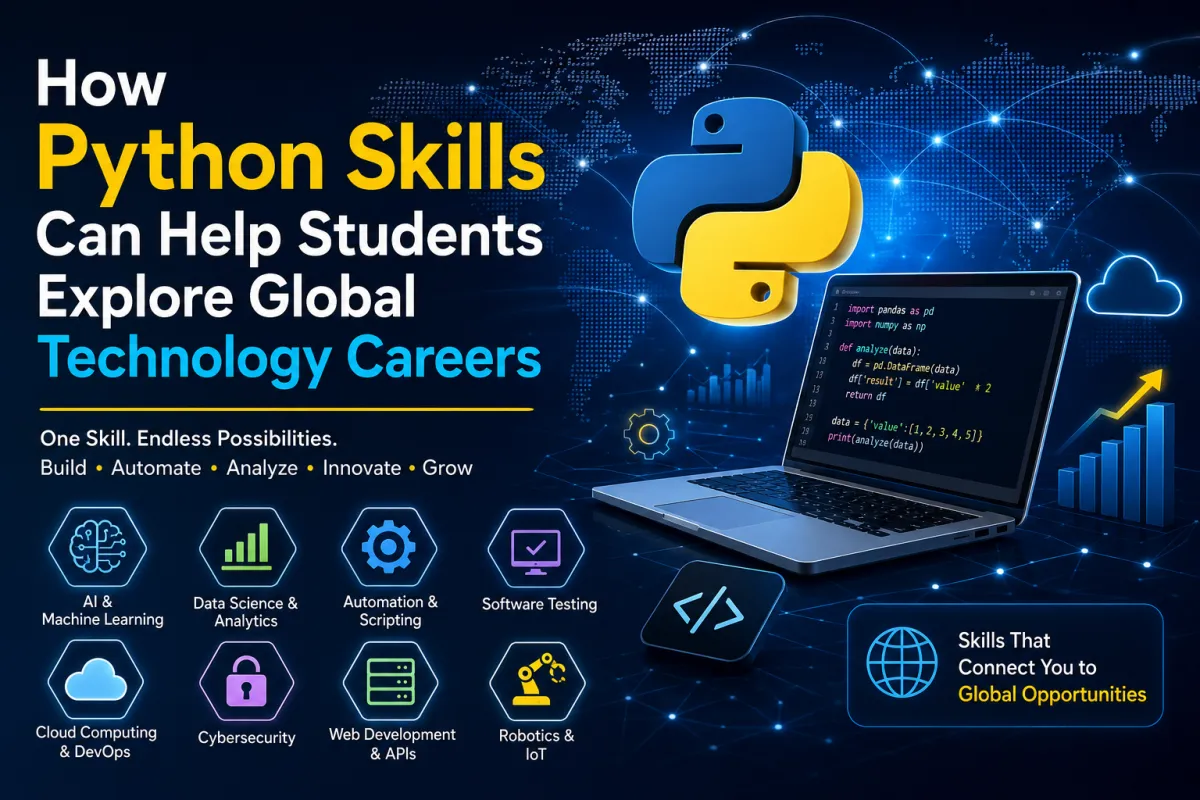
How Python Skills Can Help Students Explore Global Technology Careers
Technology careers are no longer limited by geography.
A student in India can work on a project for a company in Japan, collaborate with a developer in Europe, contribute to an open-source project with people from different countries, or build a technology product for a global audience.
To take advantage of these opportunities, students need a strong technical foundation.
One of the most useful skills to develop is Python programming.
Python is relatively beginner-friendly, but it is also used across advanced technology domains such as Artificial Intelligence, Machine Learning, Data Science, Automation, Cybersecurity, Cloud Computing, Software Testing, and Robotics.
This makes Python more than just a programming language.
It can become a foundation for exploring different technology careers.
Why Should Students Learn Python?
Students often ask:
"Which programming language should I learn first?"
There is no single answer for everyone, but Python is an excellent starting point because its syntax is comparatively easy to understand and it has a very large ecosystem of libraries, frameworks, learning resources, and developer communities.
More importantly, Python can be used across multiple career paths.
For example:
Python → Machine Learning → AI Engineer
Python → Data Analysis → Data Scientist
Python → Automation → QA Automation Engineer
Python → APIs → Backend Developer
Python → Security Tools → Cybersecurity
Python → Cloud Automation → DevOps / Cloud
This flexibility allows students to explore different areas before deciding on a specialization.
Python Is More Than a Programming Language
Learning Python should not mean simply memorizing syntax.
Students should use Python to develop problem-solving ability.
Important fundamentals include:
Variables
Data types
Conditional statements
Loops
Functions
Lists
Dictionaries
Tuples
Sets
File handling
Exception handling
Object-oriented programming
Modules and packages
APIs
Database connectivity
Once these fundamentals are comfortable, students can move into specialized areas.
Python and Artificial Intelligence
AI is one of the most exciting technology areas for students.
Python is widely used for AI and machine learning development because of its extensive ecosystem.
Students can learn:
NumPy
Pandas
Matplotlib
Scikit-learn
TensorFlow
PyTorch
OpenCV
NLP libraries
Generative AI frameworks
Example beginner project
Spam Email Classification
A student can use Python and machine learning to classify messages as:
Spam / Not Spam
This teaches:
Data preprocessing
Feature extraction
Model training
Model evaluation
Prediction
A simple project like this can become the starting point for more advanced AI projects.
Python and Data Science
Data is central to almost every industry.
Students interested in data-related careers can use Python to learn:
Python → Pandas → Data Cleaning → Visualization → Statistics → Machine Learning
Example projects:
Student performance analysis
Sales dashboard
Customer segmentation
Stock data analysis
E-commerce analysis
Social media sentiment analysis
These projects can be published on GitHub as part of a technical portfolio.
Python for Automation Testing
Python is also highly useful for software testing.
Students can combine Python with automation frameworks such as:
Selenium
Playwright
Pytest
Requests
A possible learning path is:
Manual Testing
↓
Python
↓
Selenium / Playwright
↓
API Testing
↓
Pytest
↓
CI/CD
↓
Automation Engineer / SDET
This pathway can be especially useful for students interested in software quality engineering and DevOps-related careers.
Python and Cybersecurity
Python can also be used to automate security-related tasks and develop security tools.
Students can explore areas such as:
Network programming
Log analysis
Security automation
File analysis
API security testing
Vulnerability assessment
Threat detection
For example, students could create a project that analyzes server logs and identifies suspicious activity.
The important point is to use Python for defensive and authorized security work, particularly when building a portfolio.
Python for Cloud and DevOps
Modern applications are increasingly deployed using cloud infrastructure.
Python can help students automate cloud and DevOps workflows.
Students can combine:
Python + Linux + Git + Docker + Cloud + CI/CD
Possible projects include:
Automated deployment scripts
Cloud resource monitoring
Log analysis
Backup automation
API-based infrastructure tools
CI/CD testing utilities
This combination can lead toward careers such as:
Cloud Engineer
DevOps Engineer
Automation Engineer
Site Reliability Engineer
Python and Robotics
Python also has applications in robotics and automation.
Students can explore:
Computer vision
Robot control
Sensor data
IoT
Automation
AI-powered robotics
For example:
Camera → Python → Computer Vision → Object Detection → Robot Action
This can be particularly interesting for students from:
Computer Science
Electronics
Electrical Engineering
Mechanical Engineering
Mechatronics
Python Can Connect Different Engineering Fields
One of Python's biggest advantages is that it can act as a bridge between different disciplines.
CSE Student
Python + AI + Cloud
ECE Student
Python + Embedded Systems + IoT
Mechanical Student
Python + Robotics + Automation
IT Student
Python + Testing + DevOps
Data Student
Python + Statistics + Machine Learning
This makes Python useful even if a student's degree is not purely focused on software development.
Python and Global Technology Careers
Students interested in international careers should think beyond learning a programming language.
A global technology profile can be built around:
Technical Skills + Projects + Communication + Portfolio + International Exposure
Python can become the technical foundation.
For example:
Japan-focused technology pathway
Python
AI
Automation
Japanese Language
Portfolio
European technology pathway
Python
Data Science
Cloud
English Communication
Portfolio
Global Remote Career Path
Python
Software Development
GitHub
Open Source
Communication
The exact requirements vary by country, employer, and role, but the principle remains the same:
Build skills that can be demonstrated internationally.
Why Projects Matter More Than Just Learning Python
One of the biggest mistakes students make is completing a Python course and stopping there.
A certificate says:
"I completed a course."
A project demonstrates:
"I can build something."
Employers and universities can learn much more about your capabilities from a well-documented project.
10 Python Projects Students Can Build
1. Spam Classification System
Use machine learning to classify messages.
Skills: Python, NLP, Machine Learning
2. Student Performance Analyzer
Analyze student marks and identify trends.
Skills: Python, Pandas, Data Visualization
3. Expense Tracker
Build a command-line or web-based personal expense application.
Skills: Python, File Handling, Database
4. Weather Dashboard
Retrieve weather information through an API and display it.
Skills: Python, APIs, JSON
5. Automated Website Testing
Create automated browser tests.
Skills: Python, Playwright/Selenium, Pytest
6. Resume Analyzer
Build a basic system that extracts keywords from resumes.
Skills: Python, NLP
7. Log Monitoring Tool
Analyze application logs and identify unusual patterns.
Skills: Python, Regular Expressions, Automation
8. Image Classification
Build a basic image classification model.
Skills: Python, Computer Vision, Machine Learning
9. AI Chatbot
Create a simple conversational application.
Skills: Python, APIs, NLP/Generative AI
10. Cloud Automation Script
Automate a repetitive cloud or infrastructure task.
Skills: Python, APIs, Cloud
Build Your Projects for a Global Portfolio
Your GitHub repository should not simply contain code.
Each project should ideally include:
README.md
Explain:
Problem statement
Objective
Technologies
Architecture
Installation
Usage
Screenshots
Results
Future improvements
Source Code
Keep the project organized and readable.
Documentation
Explain how the project works.
Demonstration
If possible, provide screenshots, videos, or a live demo.
This turns a simple coding exercise into a portfolio project.
Python + GitHub: A Powerful Combination
Students should learn Git and GitHub alongside Python.
Basic workflow:
Write Code
↓
Git Add
↓
Git Commit
↓
Git Push
↓
GitHub Repository
↓
Portfolio
GitHub can become a public record of your technical learning and projects.
Instead of telling a recruiter:
"I know Python."
You can show them:
"Here are five Python projects I built."
That is a much stronger conversation.
Python + AI Is Becoming an Important Combination
Students interested in the future of technology should consider combining Python with AI.
A possible roadmap:
Stage 1
Python Fundamentals
↓
Stage 2
NumPy + Pandas
↓
Stage 3
Statistics
↓
Stage 4
Machine Learning
↓
Stage 5
Deep Learning
↓
Stage 6
Generative AI
↓
Stage 7
AI Applications
↓
Stage 8
Deployment and MLOps
This can lead toward roles such as:
AI Engineer
Machine Learning Engineer
Data Scientist
AI Application Developer
ML Engineer
MLOps Engineer
Python + Automation Is Another Strong Path
Students who prefer practical engineering and testing can explore:
Python
↓
Pytest
↓
Selenium / Playwright
↓
API Testing
↓
Git
↓
CI/CD
↓
Docker
↓
Cloud
This can lead toward:
QA Automation Engineer
SDET
Test Automation Engineer
Software Quality Engineer
DevOps Test Engineer
How Students Can Prepare for International Opportunities
If your goal is to explore global technology careers, consider building your profile in five areas.
1. Technical Skills
Learn Python and one specialization.
2. Projects
Build 3–5 meaningful projects.
3. Portfolio
Maintain GitHub and LinkedIn profiles.
4. Communication
Improve technical writing, presentations, and interview skills.
5. International Exposure
Participate in:
Hackathons
Open-source projects
International webinars
Technical communities
Student competitions
Research projects
Internships
University programs
Should Students Learn Multiple Programming Languages?
Not immediately.
A common mistake is:
Python + Java + C++ + JavaScript + Go + Rust
without becoming proficient in any of them.
Instead:
First
Become comfortable with one language.
Next
Learn a specialization.
Then
Add another language when your career path requires it.
For example:
Python + AI
is more useful initially than learning five programming languages superficially.
Python Learning Roadmap for Students
Month 1 — Fundamentals
Learn:
Syntax
Variables
Conditions
Loops
Functions
Data structures
Month 2 — Intermediate Python
Learn:
OOP
File handling
Exceptions
Modules
APIs
JSON
Git
Month 3 — Choose a Specialization
Choose one:
AI / Data / Testing / Cloud / Cybersecurity / Automation
Month 4 — Build Projects
Build 2–3 projects.
Month 5 — Portfolio
Create:
GitHub repositories
Project documentation
LinkedIn posts
Technical articles
Month 6 — Career Preparation
Practice:
Technical interviews
Coding problems
Project explanation
Resume writing
Communication
This roadmap can be adjusted depending on your academic schedule and existing programming knowledge.
How Python Can Support a Japan-Focused Technology Career
For students interested in India–Japan technology opportunities, Python can be particularly useful because it connects several technology areas relevant to collaboration.
For example:
Python + AI
Python + Robotics
Python + Automation
Python + Data
Python + IoT
Python + Software Testing
A student can then add:
Japanese Language + Cross-Cultural Communication + International Portfolio
This creates a broader global profile.
The objective should not be to learn Japanese only because you want to work in Japan.
Instead, combine technical capability with cultural and communication skills to become more effective in international environments.
What Should Students Do Today?
If you are currently a student, you can start with a simple plan:
Step 1
Install Python and learn the fundamentals.
Step 2
Solve small programming problems regularly.
Step 3
Build your first practical project.
Step 4
Upload it to GitHub.
Step 5
Write a short article explaining what you built.
Step 6
Share your learning journey on LinkedIn.
Step 7
Choose a specialization.
Step 8
Build increasingly advanced projects.
Step 9
Start exploring internships and international opportunities.
Step 10
Keep improving your communication and professional skills.
Final Thoughts
Python can be a powerful starting point for students who want to explore technology careers.
But the real value does not come from simply knowing Python syntax.
The value comes from what you build with it.
Use Python to:
Solve Problems → Build Projects → Create a Portfolio → Develop Specialization → Gain Experience → Explore Global Opportunities
Whether your goal is AI, automation, software testing, data science, cybersecurity, cloud, robotics, or another technology field, Python can provide a strong foundation.
For students looking toward international careers, combine your Python skills with practical projects, GitHub, communication, industry exposure, and global awareness.
Your first Python project may be small.
But it can be the beginning of a much larger technology career.
FutureTech Simulation
At FutureTech Simulation, we focus on helping students and professionals discover practical pathways into emerging technologies and global career opportunities.
Our approach is simple:
Learn → Build → Showcase → Connect → Grow
Python is one of the skills that can help students begin that journey.
Explore our technology learning resources, project ideas, career guides, and international opportunity content to continue building your skills and preparing for the future of work.

Facebook
Instagram
X
LinkedIn
Youtube
WhatsApp