
Our Latest Articles
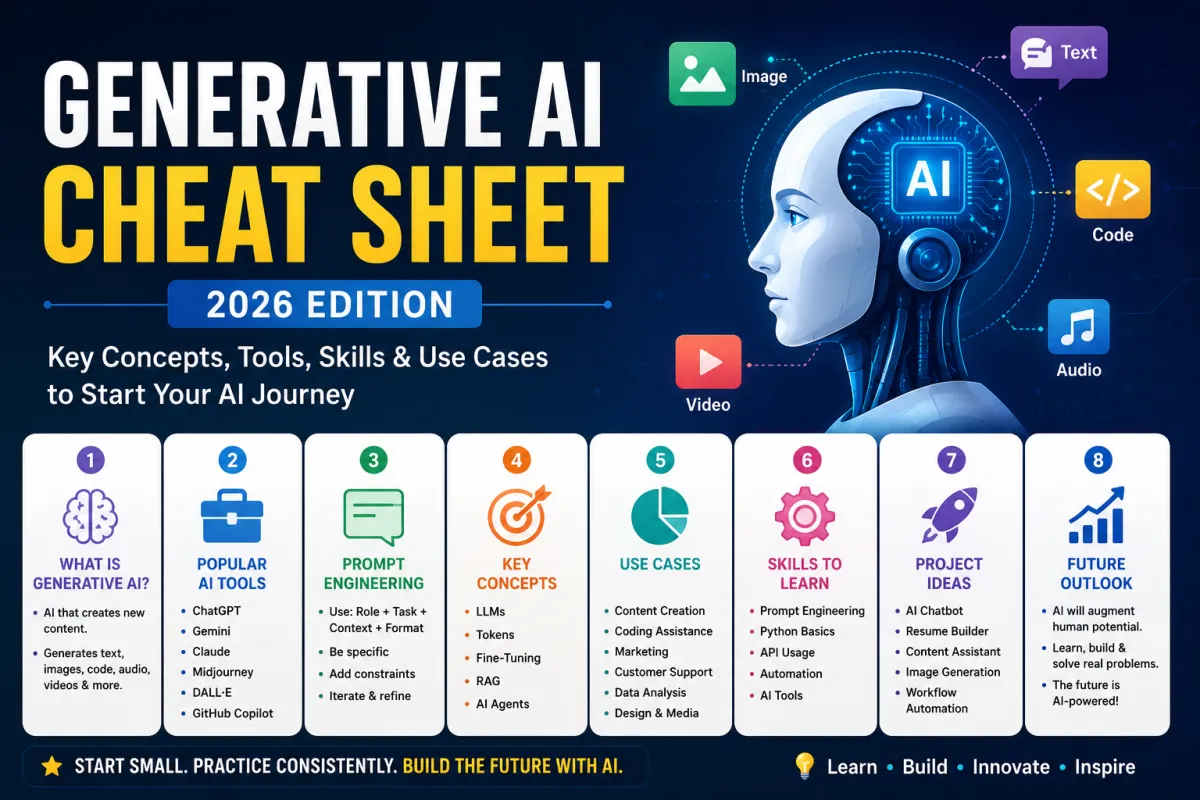
Generative AI Cheat Sheet (2026 Edition)
Generative AI is no longer just a trending topic.
It is transforming:
• Software development
• Content creation
• Customer support
• Marketing
• Education
• Data analysis
• Automation workflows
The biggest mistake many people make is trying to learn everything at once.
Instead, start with a simple roadmap and practical understanding.
This Generative AI Cheat Sheet will help you understand the fundamentals, tools, concepts, and skills required to start your AI journey in 2026.
🚀 What is Generative AI?
Generative AI refers to artificial intelligence systems that can create new content such as:
✔ Text
✔ Images
✔ Code
✔ Audio
✔ Videos
✔ Presentations
Unlike traditional AI systems that mainly analyze data, Generative AI can produce completely new outputs based on prompts and instructions.
🧠 Popular Generative AI Tools
Here are some widely used Generative AI tools:
ToolMain UseChatGPTContent, coding, automationGeminiResearch & productivityClaudeLong-form writing & analysisMidjourneyAI image generationDALL·ECreative visualsGitHub CopilotCoding assistance
👉 Different tools are designed for different purposes.
✍️ Prompt Engineering Basics
One of the most important skills in Generative AI is writing effective prompts.
✅ Simple Prompt Formula
Role + Task + Context + Output Format
Example:
Act as a software tester. Generate login test cases for an e-commerce website. Include edge cases. Output in table format.
🎯 Tips for Better Prompts
❌ Weak Prompt
“Explain AI”
✅ Better Prompt
“Explain Generative AI in simple terms for beginners with real-world examples.”
💡 Key Prompt Engineering Tips
✔ Be specific
✔ Mention audience
✔ Define output format
✔ Add constraints
✔ Refine prompts iteratively
⚙️ Important Generative AI Concepts
Understanding these terms is important for long-term growth.
🔹 LLM (Large Language Model)
Models trained on huge datasets to understand and generate human-like text.
Examples:
• GPT
• Gemini
• Claude
🔹 Tokens
AI processes text in smaller chunks called tokens.
Longer prompts = more tokens used.
🔹 Fine-Tuning
Training a pre-built AI model on custom data to improve specific tasks.
🔹 RAG (Retrieval-Augmented Generation)
A technique where AI retrieves external information before generating responses.
Used in:
✔ AI chatbots
✔ Enterprise AI systems
✔ Knowledge assistants
🔹 AI Agents
AI systems that can:
• Plan tasks
• Execute workflows
• Use tools automatically
AI agents are becoming one of the biggest trends in 2026.
📊 Real-World Use Cases of Generative AI
Generative AI is already being used in multiple industries.
💻 Software Development
• Code generation
• Bug fixing
• Documentation
• Test case creation
🧪 Software Testing
• Test automation assistance
• Scenario generation
• API testing support
📈 Marketing
• Blog writing
• Ad copy generation
• Social media content
• SEO optimization
🎨 Design & Media
• AI-generated images
• Video creation
• Voice cloning
• Presentation generation
🤝 Customer Support
• AI chatbots
• Automated replies
• Ticket classification
🛠️ Skills to Learn for Generative AI
You do not need to become a data scientist immediately.
Start with these practical skills:
✔ Prompt Engineering
✔ Python basics
✔ API integration
✔ Automation workflows
✔ AI tools usage
✔ Communication & problem-solving
🧪 Beginner Projects to Build
Learning becomes easier through projects.
Here are some beginner-friendly project ideas:
🔹 AI Resume Builder
Generate resumes using prompts.
🔹 AI Content Assistant
Create blog or LinkedIn content automatically.
🔹 AI Chatbot
Build a chatbot using OpenAI APIs.
🔹 AI Image Generator Workflow
Generate promotional visuals using AI tools.
🌍 Future of Generative AI
Generative AI is not replacing everyone.
But professionals who know how to use AI effectively will have a major advantage.
The future belongs to people who can:
✔ Combine AI + human creativity
✔ Solve real problems
✔ Build efficient workflows
🎯 Common Mistakes Beginners Make
❌ Trying too many tools at once
❌ Copy-pasting prompts blindly
❌ Learning theory without projects
❌ Ignoring fundamentals
❌ Expecting instant mastery
📚 Recommended Learning Path
Beginner Level
✔ Prompt engineering
✔ AI tools usage
✔ Basic Python
Intermediate Level
✔ APIs
✔ Workflow automation
✔ AI integrations
Advanced Level
✔ Fine-tuning
✔ AI agents
✔ Building AI products
💬 Final Thought
Generative AI is not just a technology trend.
It is becoming a core productivity skill across industries.
You don’t need to master everything today.
Start small.
Practice consistently.
Build projects.
Learn by doing.
That’s how real AI careers are built.
📩 Want More AI Learning Resources?
If you want:
✔ AI project ideas
✔ Prompt engineering templates
✔ Beginner roadmap
✔ Free AI tools & courses
👉 Fill the form below to get updates:


Facebook
Instagram
X
LinkedIn
Youtube
WhatsApp