
Our Latest Articles
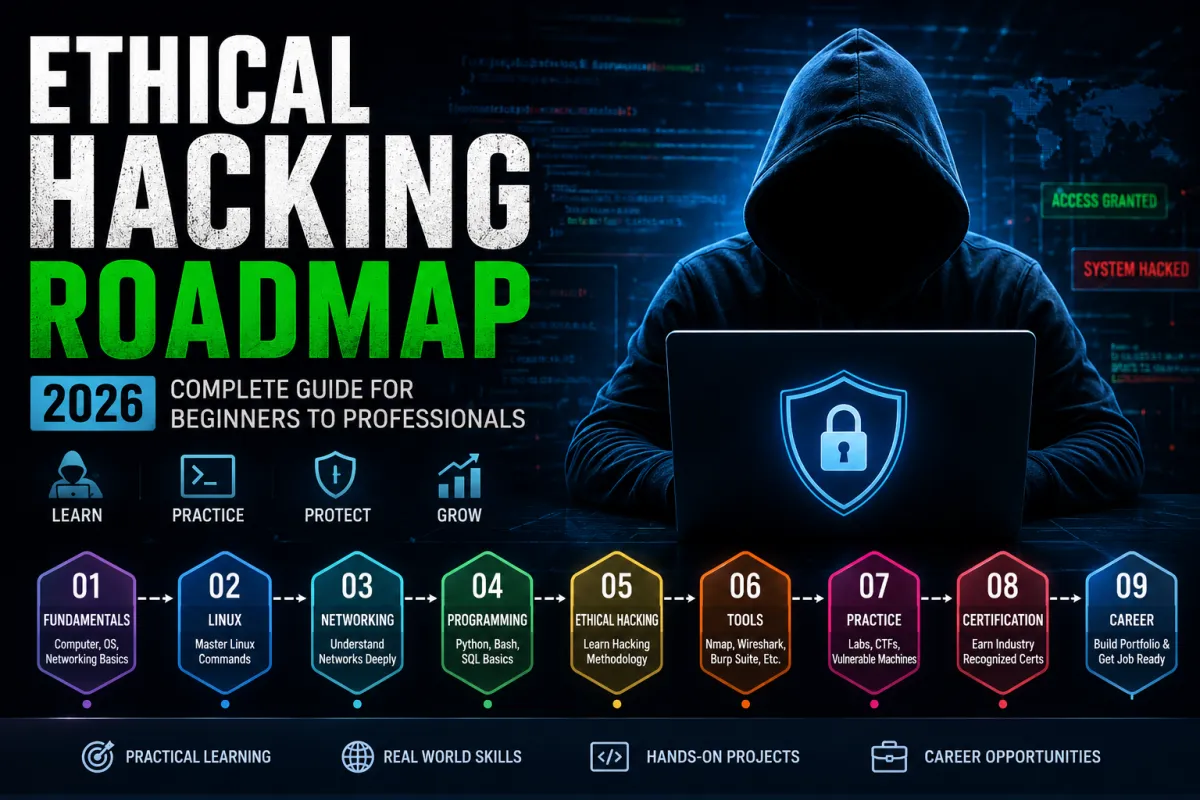
Ethical Hacking Roadmap 2026: Complete Beginner to Professional Guide
Cybersecurity has become one of the most critical fields in the digital age. As businesses, governments, and individuals increasingly depend on technology, cyber threats continue to grow in both frequency and sophistication.
Organizations are constantly looking for skilled professionals who can identify security weaknesses before cybercriminals exploit them. This is where Ethical Hackers play a crucial role.
Ethical hacking is one of the most exciting and rewarding career paths in cybersecurity. However, many students and aspiring professionals often ask:
Where should I start?
Do I need programming skills?
What tools should I learn?
Which certifications are valuable?
How long does it take to become an ethical hacker?
This roadmap answers these questions and provides a structured path from beginner to professional ethical hacker.
What is Ethical Hacking?
Ethical hacking is the process of legally testing systems, networks, applications, and digital infrastructure to identify vulnerabilities before malicious hackers can exploit them.
Ethical hackers, also known as White Hat Hackers, use the same techniques and tools as attackers but with proper authorization and for defensive purposes.
Their responsibilities include:
Vulnerability Assessment
Penetration Testing
Security Auditing
Risk Assessment
Security Monitoring
Incident Investigation
The goal is simple:
Find security weaknesses before attackers do.
Why Choose Ethical Hacking as a Career?
Ethical hacking offers numerous opportunities across industries.
High Demand
Organizations worldwide face increasing cyber threats.
Excellent Salary Potential
Cybersecurity professionals are among the highest-paid technology specialists.
Global Opportunities
Cybersecurity skills are needed across every country and industry.
Continuous Learning
The field constantly evolves with new threats and technologies.
Diverse Career Paths
Ethical hacking can lead to careers in:
Penetration Testing
Security Consulting
Security Engineering
Incident Response
Threat Intelligence
Red Team Operations
Stage 1: Build Strong IT Fundamentals
Before learning hacking techniques, you must understand how computers, operating systems, and networks function.
Learn:
Computer Fundamentals
CPU
Memory
Storage
Operating Systems
Networking Basics
IP Addressing
DNS
DHCP
Routing
Switching
Internet Fundamentals
HTTP
HTTPS
TCP/IP
VPNs
Virtualization
Virtual Machines
Hypervisors
Containers
Practical Activities
Install VirtualBox
Create Virtual Machines
Set up Windows and Linux systems
Explore system configurations
Without strong fundamentals, advanced security concepts become difficult to understand.
Stage 2: Master Linux
Linux is the backbone of cybersecurity.
Most ethical hacking tools run on Linux distributions such as Kali Linux.
Topics to Learn
Linux Commands
ls
pwd
cd
grep
find
chmod
File Systems
Directories
Permissions
Ownership
Process Management
Background Processes
Services
Scheduling
Shell Scripting
Bash Basics
Automation Scripts
Practice Goals
Navigate Linux comfortably
Install software
Create scripts
Manage users and permissions
Linux proficiency is a non-negotiable skill for ethical hackers.
Stage 3: Learn Networking in Depth
Networking is the foundation of hacking.
Most attacks involve exploiting communication between systems.
Key Concepts
OSI Model
Understand all seven layers.
TCP/IP Model
Learn how internet communication works.
Common Protocols
HTTP
HTTPS
FTP
SSH
DNS
SMTP
Network Devices
Routers
Switches
Firewalls
Wireless Networks
Wi-Fi Security
WPA2
WPA3
Tools to Explore
Wireshark
Nmap
Angry IP Scanner
Understanding network traffic is essential for identifying vulnerabilities.
Stage 4: Learn Programming
Programming helps ethical hackers automate tasks and understand vulnerabilities.
You don't need to become a software engineer, but basic programming is highly beneficial.
Recommended Languages
Python
Best starting point.
Used for:
Automation
Scanning
Reconnaissance
Security Tools
Bash
Useful for Linux automation.
JavaScript
Important for web application security.
SQL
Critical for understanding database attacks.
Mini Projects
Port Scanner
Password Generator
Log Analyzer
Network Monitoring Script
Stage 5: Understand Cybersecurity Fundamentals
Before learning attacks, understand how systems are protected.
Learn
Security Principles
Confidentiality
Integrity
Availability
Authentication
Passwords
Multi-Factor Authentication
Authorization
Access Control
Permissions
Encryption
Symmetric Encryption
Asymmetric Encryption
Risk Management
Threats
Vulnerabilities
Risk Assessment
This knowledge forms the foundation for every cybersecurity role.
Stage 6: Learn Ethical Hacking Methodology
Ethical hacking follows a structured process.
Phase 1: Reconnaissance
Gather information about targets.
Phase 2: Scanning
Identify open ports and services.
Phase 3: Enumeration
Extract useful information from systems.
Phase 4: Vulnerability Analysis
Identify weaknesses.
Phase 5: Exploitation
Test vulnerabilities safely.
Phase 6: Reporting
Document findings and recommendations.
Professional reporting is just as important as technical skills.
Stage 7: Master Ethical Hacking Tools
Every ethical hacker should know these tools.
Nmap
Network scanning and discovery.
Wireshark
Network packet analysis.
Burp Suite
Web application security testing.
Metasploit
Penetration testing framework.
Hydra
Password testing.
Nikto
Web vulnerability scanner.
OpenVAS
Vulnerability assessment platform.
Kali Linux
Industry-standard penetration testing operating system.
Focus on understanding the purpose of each tool rather than memorizing commands.
Stage 8: Learn Web Application Security
Most organizations rely heavily on web applications.
As a result, web security is one of the most valuable skills in ethical hacking.
Learn OWASP Top 10
SQL Injection
Cross-Site Scripting (XSS)
Broken Authentication
Security Misconfiguration
Cross-Site Request Forgery (CSRF)
Sensitive Data Exposure
Insecure APIs
Practice Platforms
OWASP Juice Shop
DVWA
WebGoat
Web application testing is a critical skill for modern penetration testers.
Stage 9: Build a Home Cybersecurity Lab
Practical experience is essential.
Create a safe environment for experimentation.
Recommended Setup
Virtual Machines
Kali Linux
Ubuntu
Windows
Vulnerable Systems
Metasploitable
OWASP Juice Shop
DVWA
Tools
VirtualBox
VMware
Your home lab becomes your personal cybersecurity playground.
Stage 10: Participate in Capture The Flag (CTF) Challenges
CTFs help develop real-world skills.
Popular platforms:
Hack The Box
TryHackMe
PicoCTF
OverTheWire
Benefits include:
Problem Solving
Practical Learning
Community Engagement
Portfolio Building
Stage 11: Earn Industry Certifications
Certifications help validate your knowledge.
Beginner
Google Cybersecurity Professional Certificate
ISC2 Certified in Cybersecurity (CC)
Intermediate
CompTIA Security+
eJPT
Advanced
Certified Ethical Hacker (CEH)
CompTIA PenTest+
OSCP
Certifications complement practical experience but should never replace it.
Stage 12: Build a Portfolio
Employers want proof of skills.
Create:
Security Reports
Vulnerability Assessments
Python Security Tools
CTF Write-Ups
Lab Documentation
Security Research Articles
Publish your work on:
GitHub
LinkedIn
Personal Website
A strong portfolio often opens more doors than certifications alone.
Career Opportunities in Ethical Hacking
After gaining experience, you can pursue roles such as:
Ethical Hacker
Penetration Tester
Cybersecurity Analyst
Security Engineer
SOC Analyst
Red Team Specialist
Security Consultant
Vulnerability Researcher
Cybersecurity remains one of the most future-proof technology careers.
Recommended Learning Resources
Hands-On Platforms
TryHackMe
Hack The Box
PicoCTF
OverTheWire
Learning Platforms
Coursera
Cisco Networking Academy
Microsoft Learn
AWS Skill Builder
Documentation
OWASP
NIST
MITRE ATT&CK
Communities
Reddit Cybersecurity Communities
LinkedIn Cybersecurity Groups
Discord Security Communities
12-Month Ethical Hacking Learning Plan
Months 1-2
Computer Fundamentals + Linux
Months 3-4
Networking + Security Basics
Months 5-6
Programming + Cybersecurity Concepts
Months 7-8
Ethical Hacking Methodology
Months 9-10
Web Security + Tools
Months 11-12
Projects + CTFs + Portfolio
Following a structured plan prevents information overload and accelerates learning.
Final Thoughts
Ethical hacking is not about breaking systems. It is about understanding how systems can be broken so they can be protected.
Success in ethical hacking requires:
Curiosity
Persistence
Continuous Learning
Hands-On Practice
Ethical Responsibility
Start with the fundamentals, build practical experience, create projects, participate in cybersecurity communities, and continuously improve your skills.
The demand for skilled cybersecurity professionals continues to grow, making ethical hacking one of the most exciting and rewarding career paths in technology today.


Facebook
Instagram
X
LinkedIn
Youtube
WhatsApp