
Our Latest Articles
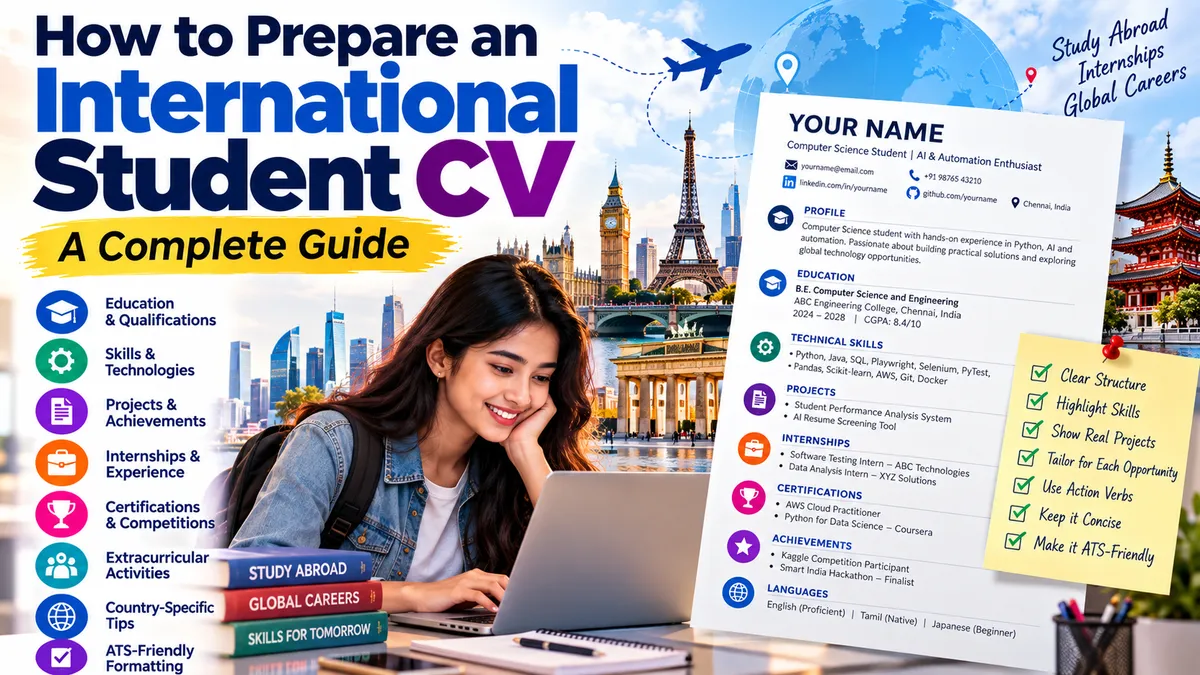
How to Prepare an International Student CV: A Complete Guide
If you are planning to study abroad, apply for an international internship, participate in a university programme, or look for your first job overseas, your CV is one of the most important documents you need to prepare.
An international student CV is more than a list of marks and certificates.
It should clearly communicate:
Who you are
What you have studied
What skills you have developed
What projects you have completed
What practical experience you have
What you can contribute
What opportunity you are looking for
The important point is that there is no single CV format that works everywhere. CV expectations vary by country, university, industry and purpose. For example, UK CV guidance commonly recommends a clean one- or two-page CV without a photograph, while European applications may use Europass where appropriate. Always check the requirements of the specific university, employer or programme.
1. What Is an International Student CV?
An international student CV is a professional document designed to present your education, skills, projects, experience, achievements and career interests to an institution or organisation outside your home country.
You may need a CV for:
🎓 University applications
🌏 Study-abroad programmes
💼 International internships
🔬 Research opportunities
🏆 Competitions and hackathons
💻 Graduate jobs
🤝 Exchange programmes
📚 Scholarships
🌐 Student conferences and international programmes
The content should be adapted according to the purpose.
For example:
University application CV
Focus on:
Academic performance
Projects
Research
Relevant subjects
Competitions
Extracurricular activities
Internship CV
Focus on:
Technical skills
Projects
Practical experience
Achievements
Relevant coursework
Graduate job CV
Focus on:
Skills
Projects
Internships
Work experience
Achievements
Job-specific evidence
2. Why Your CV Matters
Your CV is often the first document an employer, recruiter or admissions team sees.
Europass describes a CV as a snapshot of your skills, education, work experience and achievements and recommends tailoring it to the opportunity.
A strong CV should allow the reader to quickly answer:
Who is this student?
What can this student do?
What has this student actually built or achieved?
Why is this student relevant to this opportunity?
If the answers are unclear, even a student with good qualifications may struggle to communicate their potential.
3. Start With the Opportunity
Before creating your CV, identify exactly what you are applying for.
Don't create one generic CV and send the same document everywhere.
Start by asking:
What am I applying for?
For example:
Bachelor's programme
Master's programme
International internship
Research internship
Software engineering internship
AI programme
Student exchange
Scholarship
Graduate job
Then study the opportunity carefully.
Look for:
Required qualifications
Technical skills
Preferred skills
Academic requirements
Language requirements
Experience
Projects
Keywords
Application instructions
University of Dundee's international-student CV guidance specifically recommends understanding what the employer is looking for and tailoring the CV to the role and sector.
4. Basic International Student CV Structure
A practical structure is:
Name and contact information
Professional/academic profile
Education
Technical skills
Projects
Internships/work experience
Research experience
Certifications
Competitions and achievements
Leadership and extracurricular activities
Languages
Relevant additional information
You don't necessarily need every section.
Choose sections based on your experience and the opportunity.
5. Header and Contact Information
Start with your name.
Example
ARUN KUMAR
Computer Science Student | AI & Data Science Enthusiast
📧 [email protected]
📱 +91 XXXXX XXXXX
🔗 LinkedIn: linkedin.com/in/arunkumar
💻 GitHub: github.com/arunkumar
You can also include:
Portfolio website
Kaggle profile
Research profile
Relevant professional platform
Avoid unnecessary information
Don't automatically include:
Aadhaar number
Passport number
Bank details
Full family details
Parents' occupation
Religion
Political information
Only provide personal information when specifically required by the application.
6. Should You Include Your Photograph?
This depends on the country and application.
There is no universal international rule.
For example, University of Dundee's UK CV guidance states that photographs are generally not included in UK-style CVs and employers do not expect them.
Therefore:
Don't add a photo simply because you are applying internationally.
Check the requirements for the destination country, university or employer.
If the application specifically requests a photograph, follow those instructions.
7. Write a Strong Profile Summary
Your profile should be short and specific.
Avoid generic statements such as:
"I am a hardworking, passionate and highly motivated student looking for opportunities to enhance my career."
This doesn't tell the reader much.
Instead, explain:
Who you are + what you study + your relevant skills + your goal
Example — Computer Science Student
Computer Science undergraduate with hands-on experience in Python, machine learning and data analysis. Developed academic and personal projects using Pandas, Scikit-learn and Power BI. Interested in AI, data science and international technology opportunities.
Example — Software Testing Student
IT graduate with practical experience in Python, Selenium, Playwright and API testing. Built automation projects using PyTest and GitHub and interested in software quality engineering and test automation internships.
Example — Engineering Student
Mechanical engineering student with an interest in robotics, automation and smart manufacturing. Completed projects involving Python, sensors and basic automation systems and currently developing skills in robotics and industrial technology.
Keep the profile relevant to the opportunity.
8. Education Section
For students, education is one of the most important sections.
Use reverse chronological order, starting with your current or most recent qualification. This is also recommended in Europass guidance.
Example
B.E. Computer Science and Engineering
ABC Engineering College, Chennai, India
2024–2028
CGPA: 8.4/10
Relevant coursework:
Data Structures
Database Management Systems
Machine Learning
Computer Networks
Operating Systems
For international applications, make the qualification understandable.
For example:
Instead of:
B.Tech CSE
Use:
Bachelor of Technology in Computer Science and Engineering
This helps an international reader understand your qualification.
Europass also notes that students preparing to study abroad can provide qualification-level information to help institutions understand their educational background.
9. Should You Include Your School Education?
If you are applying for your first Bachelor's degree, school education can be relevant.
For example:
Class XII – CBSE
XYZ School, Chennai
2026
Percentage: 89%
For a Master's application, however, your undergraduate degree should normally receive much more emphasis.
Avoid filling your CV with old information that doesn't add value.
10. Technical Skills
Don't simply create a huge list of technologies.
For example:
Python, Java, C, C++, JavaScript, HTML, CSS, SQL, AWS, Azure, Docker, Kubernetes, TensorFlow, PyTorch, Selenium, Jenkins...
This can look unfocused if you cannot demonstrate those skills.
Instead, organise them.
Example
Programming:
Python, Java, SQL
Testing:
Playwright, Selenium, PyTest
Data:
Pandas, NumPy, Power BI
AI/ML:
Scikit-learn, basic NLP, Generative AI
Cloud & DevOps:
AWS, GitHub Actions, Docker
This makes the CV easier to read.
11. Don't Claim Skills You Cannot Demonstrate
One common mistake students make is adding technologies simply because they watched a tutorial.
If you list:
TensorFlow
be prepared to explain:
What it is
Why you used it
What you built
What problems you encountered
The same applies to:
AI
Cloud
Kubernetes
Docker
Cybersecurity
Data Science
A smaller list of demonstrated skills is generally more useful than a huge list of unfamiliar tools.
12. Projects Are Extremely Important for Students
Students often worry:
"I don't have work experience. What should I put in my CV?"
Projects can provide evidence of practical learning.
A project should answer:
What did you build?
What technology did you use?
What problem did you solve?
What was the result?
13. Example of a Weak Project Description
Student Management System
Created a student management system using Python.
This is too vague.
14. Better Project Description
Student Performance Analysis System
Technologies: Python, Pandas, Matplotlib, Scikit-learn
Developed a Python-based system to analyse student performance data.
Cleaned and processed datasets using Pandas.
Created visualisations to identify performance patterns.
Built a basic prediction model using Scikit-learn.
Documented the project and source code on GitHub.
Now the reader can understand your contribution.
15. Use Numbers When They Are Genuine
Quantified achievements can make project descriptions clearer.
For example:
Automated 40+ regression test cases using Playwright.
Analysed a dataset containing 10,000+ records.
Reduced manual report preparation from approximately 2 hours to 20 minutes.
Only use numbers you can support.
Never invent metrics just to make a CV look impressive.
16. Use Action Verbs
Start bullet points with strong verbs.
Examples:
Developed
Built
Designed
Automated
Analysed
Implemented
Tested
Created
Integrated
Configured
Researched
Presented
Coordinated
Optimised
Documented
Instead of:
Responsible for Python project
Write:
Developed a Python-based data analysis application using Pandas and Matplotlib.
17. Internships and Work Experience
If you have an internship, include:
Company Name
Role
Location | Dates
Then add 2–5 relevant bullet points.
Example
ABC Technologies
Software Testing Intern
Chennai, India | May 2026 – July 2026
Created automated web tests using Playwright.
Developed reusable page-object components.
Executed API tests using Postman.
Logged and tracked defects using Azure DevOps.
Participated in sprint planning and daily stand-ups.
18. What If You Have No Internship?
Don't leave the CV empty.
You can include:
Academic projects
Personal projects
Open-source contributions
Freelance work
Volunteer technology projects
Student organisations
Hackathons
Competitions
Research projects
Campus responsibilities
These can demonstrate transferable skills.
19. Certifications
Certifications can support your profile, but don't allow them to dominate your CV.
Include certifications relevant to the opportunity.
Example
Certifications
Python for Data Science — IBM
AWS Cloud Practitioner
Machine Learning Fundamentals — Coursera
Selenium WebDriver Automation — XYZ
Microsoft Azure Fundamentals
If you have 20 certificates, you don't necessarily need to list all 20.
Select the most relevant ones.
20. Competitions and Hackathons
International universities and employers can learn a lot from competition participation.
Include:
Competition name
Your role
Technology used
Result, if meaningful
Project or problem solved
Example
Kaggle Machine Learning Competition
Developed a Python-based machine learning pipeline.
Performed data preprocessing and feature engineering.
Experimented with multiple classification algorithms.
Collaborated with two student teammates.
This demonstrates practical problem-solving.
21. Research Experience
For students applying to:
Research internships
Master's programmes
PhD programmes
University research projects
research experience can be particularly valuable.
Include:
Research Project Title
Research question
Methodology
Tools
Findings
Your contribution
Example
Computer Vision-Based Object Detection
Investigated image classification techniques using Python.
Preprocessed image datasets using OpenCV.
Experimented with machine-learning models.
Evaluated model performance using accuracy and F1-score.
22. Leadership and Extracurricular Activities
Don't ignore activities outside academics.
Relevant examples include:
Coding club
Robotics club
Student association
Technical symposium
Hackathon organisation
Volunteer teaching
Entrepreneurship
Sports leadership
Event coordination
Focus on what you actually did.
Example
Technical Club Coordinator
Coordinated a team of 15 student volunteers.
Organised three technical workshops.
Managed event registration and communication.
Supported speakers during technical sessions.
This demonstrates leadership and organisation.
23. Languages
Language skills can be particularly relevant for international applications.
Example:
Languages
Tamil — Native
English — Professional working proficiency
Japanese — Beginner (A1/N5 preparation)
Don't claim fluency unless you can genuinely communicate at that level.
Where appropriate, use recognised proficiency frameworks such as CEFR.
24. Should You Mention Your Home Country?
Usually, your nationality does not need to be prominently displayed unless the application requires it.
Your location can be useful:
Chennai, India
rather than writing a long residential address.
For international job applications, also check whether the employer requests information about work authorization or visa status.
25. Visa and Work Authorization
This is an important issue for international students.
If a job application asks about:
Work authorization
Visa status
Sponsorship
Right to work
answer accurately.
Don't write:
"Eligible to work anywhere in Europe."
unless you actually have the legal status to do so.
Visa and work authorization rules vary by country.
26. Keep the CV Easy to Read
A CV should be easy to scan.
Use:
Clear headings
Consistent fonts
Bullet points
Adequate spacing
Simple formatting
Consistent dates
Clear section hierarchy
University of Dundee recommends clean layouts and notes that highly complex templates can create problems with Applicant Tracking Systems (ATS).
Avoid:
❌ Excessive graphics
❌ Multiple fonts
❌ Huge blocks of text
❌ Decorative icons everywhere
❌ Difficult-to-read colours
❌ Complex tables
❌ Unnecessary charts
27. ATS-Friendly CV
Many employers use Applicant Tracking Systems to process applications.
A simple CV structure is generally easier for such systems to interpret.
Use standard headings such as:
Education
Experience
Skills
Projects
Certifications
Achievements
Avoid putting critical information inside complicated graphics or images.
28. How Long Should an International Student CV Be?
There is no universal page limit.
It depends on:
Country
Industry
Experience level
Application type
Employer instructions
For UK graduate applications, University of Dundee recommends a standard CV of one or two full pages.
Europass guidance also emphasises keeping the CV concise and focused on relevant information.
For a student with limited experience, one well-structured page or two concise pages is often a practical starting point.
Don't reduce the font size simply to squeeze everything onto one page.
29. Country-Specific CV Rules Matter
One of the most important lessons for international students is:
Don't assume that one CV format works everywhere.
For example:
UK
Generally:
1–2 pages
Clean layout
No photo
Relevant information
Reverse chronological order
University of Dundee's current guidance reflects these conventions.
Europe
Europass is an established European CV format and can be used for jobs, education, training and volunteering.
United States
Many employers commonly use the term resume and often expect a concise document. Requirements can differ by sector.
Other countries
Requirements may vary regarding:
Photo
Personal details
Length
Formatting
Language
References
Always research the destination country and specific organisation.
30. Europass CV — When Should You Consider It?
Europass is the official European Union CV platform.
It allows students to maintain a profile containing:
Education
Work experience
Skills
Languages
Projects
Achievements
You can then create different CV versions for different applications.
Europass also provides tools for creating CVs and cover letters and sharing profiles with employers and organisations in Europe.
Official resource
However, don't assume that Europass is mandatory for every European application. Follow the specific application instructions.
31. Create a Master CV
Instead of editing the same CV from scratch every time, create a Master CV.
Your master document can contain:
All education
All projects
All internships
All certifications
All technical skills
All competitions
All achievements
All extracurricular activities
All volunteer work
Then create shorter, targeted versions.
For example:
Version 1
AI Internship CV
Version 2
Software Testing Internship CV
Version 3
Data Science Internship CV
Version 4
University Application CV
Version 5
International Technology Programme CV
This approach saves time and makes tailoring easier.
32. Tailor Your CV for Every Opportunity
Suppose a company is looking for:
Python
SQL
Data Analysis
Machine Learning
Your CV should make those relevant skills easy to find if you genuinely have them.
Don't simply copy keywords into the skills section.
Demonstrate them through your experience.
For example:
Skill: Python
Evidence:
Developed a Python-based student performance prediction model using Pandas and Scikit-learn.
That is much stronger than simply writing:
Python — Advanced
without evidence.
33. Use the Job Description as a Guide
Take the job description and identify:
Technical keywords
Python
SQL
AWS
React
Selenium
Soft skills
Communication
Teamwork
Problem-solving
Responsibilities
Testing
Data analysis
Development
Documentation
Then review your CV.
Ask:
Does my CV clearly demonstrate the skills relevant to this position?
University of Manchester similarly recommends tailoring applications to the employer's requirements and providing evidence for the skills requested.
34. LinkedIn and GitHub Should Support Your CV
Your CV should not exist in isolation.
Create consistency across:
CV + LinkedIn + GitHub + Portfolio
For example:
Your CV says:
Python Developer
Your GitHub should contain Python projects.
Your LinkedIn should reflect your current skills and interests.
Your portfolio should showcase your strongest work.
This creates a more coherent professional profile.
35. Create a Strong GitHub Profile
For technology students, GitHub can provide evidence of practical skills.
Your repository should ideally include:
Clear project name
README
Problem statement
Technologies used
Installation instructions
Screenshots
Results
Future improvements
A project without documentation can be difficult for someone else to understand.
36. Use AI Carefully When Creating Your CV
AI tools can help with:
Improving grammar
Finding repetitive language
Suggesting stronger bullet points
Comparing your CV with a job description
Identifying missing information
Improving structure
But don't allow AI to invent:
Skills
Projects
Achievements
Job responsibilities
Numbers
Certifications
Research results
Your CV should remain accurate and authentic.
University of Manchester's career guidance recommends using personal research, authentic voice and judgement when using AI for applications.
37. Common International Student CV Mistakes
❌ Mistake 1: Using the same CV everywhere
Different countries and employers have different expectations.
❌ Mistake 2: Listing every certificate
Relevance matters more than quantity.
❌ Mistake 3: Writing long paragraphs
Use concise bullet points.
❌ Mistake 4: Adding skills without evidence
Be prepared to demonstrate what you claim.
❌ Mistake 5: Using complicated templates
Simple layouts are easier to read and can be more ATS-friendly.
❌ Mistake 6: Including false achievements
Never exaggerate your experience.
❌ Mistake 7: Ignoring grammar
International applications require professional written communication.
❌ Mistake 8: Using one generic profile summary
Tailor it to the opportunity.
❌ Mistake 9: Forgetting project links
Where appropriate, provide GitHub, portfolio or relevant project links.
❌ Mistake 10: Not checking application instructions
If the university or employer specifies a format, follow it.
38. International Student CV Checklist
Before submitting your CV, check:
Personal Information
☐ Name is correct
☐ Professional email address
☐ Phone number with country code
☐ LinkedIn updated
☐ GitHub/portfolio links working
Education
☐ Degree title is clear
☐ Institution name is clear
☐ Dates are correct
☐ GPA/percentage included where relevant
☐ Relevant coursework included where useful
Skills
☐ Skills are relevant
☐ No exaggerated claims
☐ Technologies are grouped logically
Projects
☐ 2–4 relevant projects
☐ Technologies mentioned
☐ Your contribution explained
☐ Results included where appropriate
☐ Links work
Experience
☐ Internship details are clear
☐ Responsibilities use action verbs
☐ Achievements are demonstrated
Formatting
☐ Consistent fonts
☐ Consistent dates
☐ Clear headings
☐ No unnecessary graphics
☐ No spelling errors
☐ Appropriate length
Final Review
☐ Tailored to the opportunity
☐ Keywords match the genuine requirements
☐ Application instructions checked
☐ PDF version created if requested
☐ File name is professional
39. Professional CV File Name
Don't submit:
resume_final_final2.pdf
Use something professional.
For example:
Arun_Kumar_CV_AI_Internship.pdf
or
Arun_Kumar_International_Student_CV.pdf
This makes your document easier to identify.
40. A Simple International Student CV Template
You can use this structure as a starting point:
YOUR NAME
City, Country | Phone | Email
LinkedIn | GitHub | Portfolio
PROFILE
2–4 lines describing your education, key skills, relevant experience and career interest.
EDUCATION
Degree Name
University Name, Country
Year – Year
CGPA/Grade
Relevant coursework: Subject 1, Subject 2, Subject 3
TECHNICAL SKILLS
Programming: Python, Java, SQL
Automation: Playwright, Selenium, PyTest
Data: Pandas, NumPy, Power BI
Cloud: AWS, Azure
Tools: Git, GitHub, Docker
PROJECTS
Project Name
What you developed
Technologies used
Problem solved
Result achieved
Project Name
What you developed
Technologies used
Result
EXPERIENCE
Company / Organisation
Role | Dates
Responsibility or achievement
Responsibility or achievement
Technology used
Result
CERTIFICATIONS
Certification — Organisation
Certification — Organisation
ACHIEVEMENTS
Competition / award
Hackathon / achievement
Scholarship / academic achievement
LEADERSHIP & ACTIVITIES
Student club
Volunteer activity
Leadership role
LANGUAGES
English — Level
Tamil — Level
Japanese — Level
41. The 5-Question CV Test
Before submitting your CV, ask yourself:
1. Can someone understand my background in 10 seconds?
2. Can they identify my strongest skills quickly?
3. Can they see evidence of my skills?
4. Does the CV match the opportunity?
5. Is every important claim accurate?
If the answer is yes, your CV is much more likely to communicate your profile clearly.
42. Final Thoughts
An international student CV should not try to make you look like someone you are not.
It should make your real skills, education, projects and achievements easy to understand to someone who may be unfamiliar with your country or educational system.
The strongest approach is:
Learn → Build → Document → Tailor → Apply
Don't wait until you are ready to graduate.
Start building your CV from your first year.
Every project, competition, internship, certification, research activity and leadership experience can gradually strengthen your professional profile.
And remember:
Your CV is not a record of everything you have ever done.
It is a focused presentation of the experiences and skills that are relevant to the opportunity you are pursuing.
🌏 FutureTech Simulation
At FutureTech Simulation, we help students prepare for international technology and career opportunities through:
💻 Technical Skills
🤖 AI & Automation
📊 Data & Analytics
🧪 Software Testing
☁️ Cloud & DevOps
🌏 Global Career Exploration
📁 Portfolio & Project Development
💼 Career Readiness
Our approach is simple:
Learn → Build → Showcase → Explore Global Opportunities
If you're a student planning to study abroad, apply for an international internship or build a global technology career, start preparing your CV and portfolio early.


Facebook
Instagram
X
LinkedIn
Youtube
WhatsApp