
Our Latest Articles
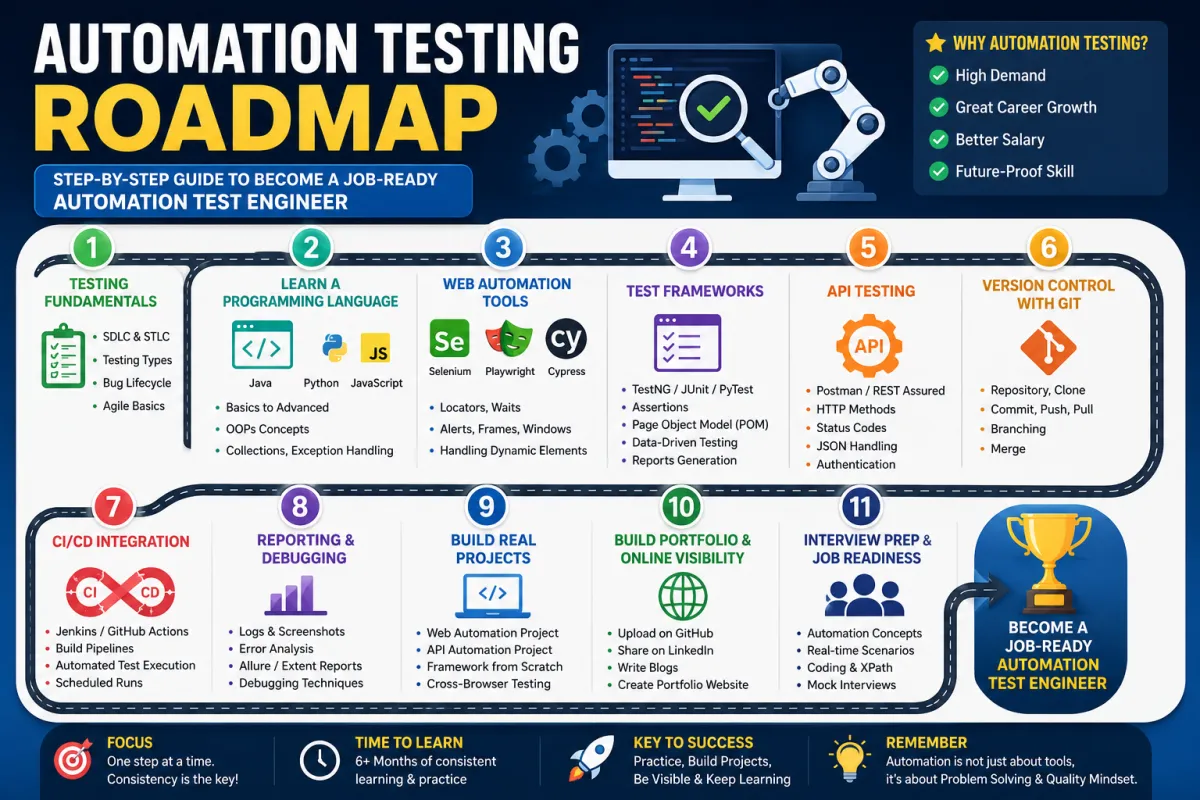
🧪 Automation Testing Roadmap (2026 Complete Beginner Guide)
Automation Testing has become one of the most in-demand skills in the software industry.
Modern companies want:
✔ Faster releases
✔ Better software quality
✔ Continuous testing
✔ CI/CD integration
This is why Automation Test Engineers are highly valuable today.
But many beginners feel confused:
• Which language should I learn?
• Which tool is best?
• Is manual testing required first?
• How long does it take to become job-ready?
This roadmap will give you a clear step-by-step path to become an Automation Test Engineer in 2026.
🚀 Step 1: Understand Software Testing Fundamentals
Before automation, you must understand testing basics.
📘 Learn These Concepts First
✔ SDLC (Software Development Life Cycle)
✔ STLC (Software Testing Life Cycle)
✔ Bug Lifecycle
✔ Types of Testing
✔ Agile & Scrum basics
🧪 Types of Testing to Learn
• Functional Testing
• Regression Testing
• Smoke Testing
• Sanity Testing
• Integration Testing
• System Testing
• UAT (User Acceptance Testing)
👉 Strong fundamentals make automation easier.
💻 Step 2: Learn a Programming Language
Automation testing requires coding.
You do NOT need to become a full software developer, but you must understand programming basics.
🔥 Best Languages for Automation
Java
Most widely used with Selenium.
Python
Easy for beginners and very popular.
JavaScript
Useful for Playwright and Cypress.
👉 Choose ONE language and go deep.
📘 Topics to Learn
✔ Variables & data types
✔ Conditions & loops
✔ Functions
✔ OOP concepts
✔ Exception handling
✔ Collections / Arrays
🌐 Step 3: Learn Web Automation
This is the core of automation testing.
🔧 Popular Automation Tools
Selenium
Industry-standard automation tool.
Playwright
Modern framework with fast execution.
Cypress
Popular for frontend testing.
👉 Beginners can start with Selenium or Playwright.
📘 Important Topics
✔ Locators (XPath, CSS selectors)
✔ Handling waits
✔ Dropdowns & alerts
✔ Frames & windows
✔ Dynamic elements
🧪 Step 4: Learn Test Frameworks
Frameworks help organize automation projects professionally.
🔧 Popular Frameworks
Java
• TestNG
• JUnit
Python
• PyTest
JavaScript
• Jest / Mocha
📘 Framework Concepts
✔ Assertions
✔ Test execution
✔ Reporting
✔ Data-driven testing
✔ Page Object Model (POM)
👉 Framework knowledge is critical for interviews.
🔗 Step 5: Learn API Testing
Modern applications heavily rely on APIs.
Automation engineers are expected to validate APIs too.
🔧 Tools to Learn
• Postman
• REST Assured
• Swagger
📘 API Concepts
✔ GET / POST / PUT / DELETE
✔ Status codes
✔ JSON handling
✔ Authentication
✔ Request & response validation
⚙️ Step 6: Learn Version Control (Git)
Automation projects are managed using Git.
📘 Learn
✔ Git clone
✔ Commit
✔ Push / Pull
✔ Branching
✔ Merge basics
👉 Essential for team collaboration.
🚀 Step 7: Learn CI/CD Basics
Automation is powerful when integrated into pipelines.
🔧 Tools to Learn
• Jenkins
• GitHub Actions
• Azure DevOps
📘 Concepts
✔ Build pipelines
✔ Automated execution
✔ Scheduled test runs
✔ Continuous Integration
👉 This is where QA meets DevOps.
📊 Step 8: Reporting & Debugging
Automation engineers spend significant time debugging failures.
📘 Learn
✔ Reading logs
✔ Screenshot capture
✔ Report generation
✔ Error analysis
🔧 Reporting Tools
• Allure Reports
• Extent Reports
📂 Step 9: Build Real Projects
This is the MOST important step.
Many people learn tools but never build projects.
🧪 Beginner Project Ideas
✔ Login page automation
✔ E-commerce checkout flow
✔ API validation project
✔ Cross-browser testing framework
👉 Projects become your portfolio.
🌍 Step 10: Build Portfolio & Visibility
Show your work publicly.
📌 Platforms to Use
✔ GitHub
✔ LinkedIn
✔ Portfolio website
💡 Share
• Framework screenshots
• Testing insights
• Automation projects
• Cheat sheets
👉 Visibility creates opportunities.
💼 Step 11: Prepare for Interviews
Automation interviews usually focus on:
✔ Selenium concepts
✔ Framework design
✔ XPath writing
✔ Java/Python basics
✔ API testing
✔ Real-time scenarios
🎯 Common Scenario Questions
• How do you handle dynamic elements?
• How do you manage flaky tests?
• How would you automate login with OTP?
• How do you integrate tests into CI/CD?
⏳ How Long Does It Take?
Approximate timeline:
LevelTimeBasics1–2 monthsAutomation tools2–4 monthsFrameworks + API4–6 monthsJob-ready level6+ months
👉 Consistency matters more than speed.
❌ Common Mistakes Beginners Make
❌ Learning too many tools at once
❌ Ignoring programming basics
❌ Watching tutorials without practice
❌ Not building projects
❌ Memorizing interview answers
🎯 Recommended Learning Path (Simple Version)
Beginner
✔ Testing basics
✔ Programming basics
✔ Selenium / Playwright
Intermediate
✔ Frameworks
✔ API Testing
✔ Git + CI/CD
Advanced
✔ Cloud testing
✔ Performance testing
✔ Test architecture
✔ AI-assisted testing
🌟 Future of Automation Testing
Automation testing is evolving with:
✔ AI-powered testing
✔ Self-healing frameworks
✔ Low-code automation
✔ Continuous testing pipelines
Automation Engineers who adapt to AI & DevOps will have huge opportunities in 2026 and beyond.
💬 Final Thought
Automation testing is not just about tools.
It’s about:
✔ Problem-solving
✔ Structured thinking
✔ Quality mindset
✔ Continuous learning
You don’t need to learn everything immediately.
Start with:
👉 One language
👉 One tool
👉 One framework
👉 One project
And build consistently.
📩 Want More Learning Resources?
If you want:
✔ Automation testing cheat sheets
✔ Beginner projects
✔ Interview questions
✔ Learning roadmap guidance
👉 Fill the form below to get updates:


Facebook
Instagram
X
LinkedIn
Youtube
WhatsApp