
Our Latest Articles
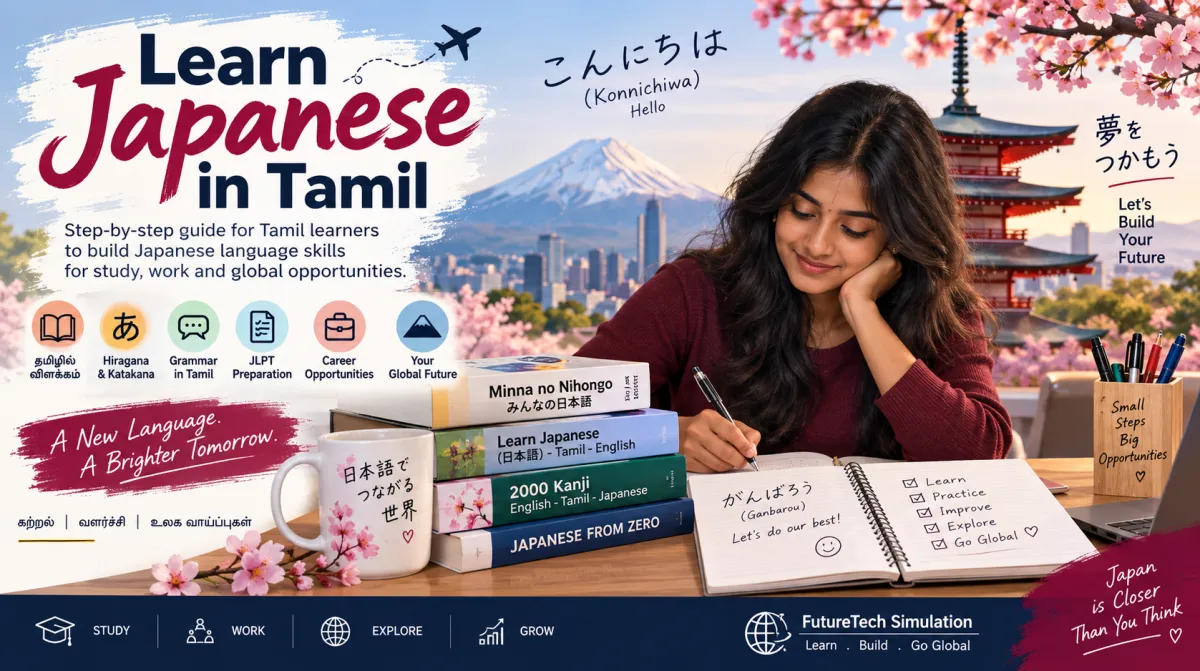
Learn Japanese in Tamil: A Practical Guide for Beginners
Thinking about learning Japanese but finding English-only explanations difficult?
If Tamil is your strongest language, learning Japanese through Tamil explanations can make the early stages much easier to understand—particularly when you're learning sentence structure, grammar, particles, and everyday expressions.
There are also some useful resources specifically designed for Tamil-speaking learners, including Tamil-language books, online lessons, and courses.
This guide explains how to start learning Japanese in Tamil, what to study first, which books you can consider, and how Japanese language skills can eventually support education and career opportunities connected with Japan.
🇯🇵 Why Learn Japanese Through Tamil?
Japanese and Tamil are not the same language, and learners should not assume that they belong to the same language family.
However, Tamil speakers may find some Japanese sentence patterns easier to understand when grammar is explained through Tamil rather than through English.
For example:
English
I eat rice.
Tamil
நான் சாதம் சாப்பிடுகிறேன்.
Japanese
私はご飯を食べます。
Watashi wa gohan o tabemasu.
The basic sentence order can be explained more intuitively to a Tamil-speaking beginner when the teacher compares the structures directly.
This is one reason Tamil-medium Japanese learning resources have developed.
A published three-volume work, Learn Japanese, was specifically created in Japanese, Tamil and English, with its origins in teaching Japanese through Tamil. The book was associated with the Institute of Asian Studies in Chennai.
📚 What Should You Learn First?
Don't start by trying to memorize hundreds of Japanese words.
Follow a structured progression.
Step 1 — Hiragana
Hiragana is one of the fundamental Japanese writing systems.
Start with:
あ い う え お
Then gradually learn the remaining characters.
Your first objective should be:
Recognize → Read → Write → Pronounce
Don't rush this stage.
Step 2 — Katakana
Katakana is commonly used for foreign-origin words, names, and certain other purposes.
For example:
コンピューター
Konpyūtā
Computer
ホテル
Hoteru
Hotel
Students interested in technology will encounter Katakana frequently when reading Japanese technology-related terms.
Step 3 — Basic Japanese Vocabulary
Start with practical vocabulary.
Greetings
こんにちは
Konnichiwa
வணக்கம் / Hello
おはようございます
Ohayō gozaimasu
காலை வணக்கம் / Good morning
ありがとうございます
Arigatō gozaimasu
நன்றி / Thank you
すみません
Sumimasen
மன்னிக்கவும் / Excuse me
Step 4 — Basic Sentence Structure
One of the first important concepts is that Japanese commonly follows:
Subject + Object + Verb
For example:
私は 日本語を 勉強します。
Watashi wa Nihongo o benkyō shimasu.
I study Japanese.
Tamil learners can compare this with the familiar subject-object-verb structure of Tamil.
This doesn't mean Japanese grammar is identical to Tamil. There are many important differences, particularly in particles, politeness, verb forms, counters, and usage.
Step 5 — Learn Japanese Particles
Particles are extremely important.
Begin with:
は — wa
Topic marker.
が — ga
Subject marker.
を — o
Object marker.
に — ni
Often indicates destination, time, or other relationships.
で — de
Often indicates the place or means of an action.
の — no
Often indicates possession or relationship.
と — to
Can indicate "and" or "with," depending on context.
Understanding particles is one of the foundations of Japanese grammar.
Step 6 — Learn Basic Verb Forms
Start with commonly used verbs.
食べます
Tabemasu — eat
飲みます
Nomimasu — drink
行きます
Ikimasu — go
来ます
Kimasu — come
見ます
Mimasu — see/watch
します
Shimasu — do
勉強します
Benkyō shimasu — study
Then gradually learn:
Present
Past
Negative
Past negative
Te-form
Plain form
Potential form
Passive form
Causative form
Don't attempt all of these at once.
🈶 Step 7 — Start Kanji Gradually
Kanji can seem intimidating at first.
Don't try to learn hundreds of characters immediately.
Start with simple characters such as:
日 — day / sun
月 — month / moon
人 — person
山 — mountain
川 — river
学 — study
生 — life / birth
大 — big
小 — small
Once you understand the basic writing systems and vocabulary, gradually introduce Kanji into your daily study.
🎯 What Is JLPT?
If you want to study Japanese seriously, you will probably encounter the Japanese-Language Proficiency Test (JLPT).
The JLPT has five levels:
N5 → N4 → N3 → N2 → N1
N5 is the easiest level and N1 is the most advanced. N4 and N5 focus on understanding basic Japanese, while N3 acts as a bridge toward the more advanced levels.
A simple progression
N5
↓
Basic Japanese
↓
N4
↓
Elementary Japanese
↓
N3
↓
Intermediate Japanese
↓
N2
↓
Advanced practical Japanese
↓
N1
↓
Advanced proficiency
📘 JLPT N5: Where Should a Beginner Start?
For someone starting from zero, N5 is a sensible first target.
The JLPT describes N5 as the ability to understand some basic Japanese, including typical expressions and sentences written using Hiragana, Katakana and basic Kanji, and to understand simple conversations in familiar situations.
A beginner N5 roadmap can look like:
Hiragana
↓
Katakana
↓
Basic vocabulary
↓
Basic Kanji
↓
Particles
↓
Basic grammar
↓
Listening
↓
Reading
↓
Speaking practice
↓
Mock tests
📚 Best Books for Learning Japanese Through Tamil
There are not as many Tamil-specific Japanese textbooks as there are English-language resources.
However, you have several options.
1. Learn Japanese — Japanese, Tamil & English
This is one of the most interesting resources for Tamil-speaking learners.
The Learn Japanese three-volume set is associated with the Institute of Asian Studies in Chennai and is written in Japanese, Tamil and English. The available description specifically explains that the material was developed to help Tamil students learn Japanese.
Learn Japanese – Three-Volume Set reference
Because it is an older/rare set, availability may vary.
📕 2. Minna no Nihongo
Minna no Nihongo is one of the most widely used Japanese textbook series.
The official publisher, 3A Corporation, describes it as a long-running textbook series for Japanese teachers and learners. The Elementary series includes a main textbook plus supplementary materials such as translation/grammar notes, workbooks, Kanji materials and listening resources.
Minna no Nihongo – Official 3A Corporation Catalogue
Important for Tamil learners
The official translation/grammar notes are available in several languages, but Tamil is not currently listed among the official translation languages shown by 3A Corporation.
Therefore, a good strategy is:
Tamil explanation resource + Minna no Nihongo + Japanese audio
This gives you Tamil support while exposing you to a standard Japanese textbook.
📗 Which Edition of Minna no Nihongo?
This is important because the series is currently transitioning to its Third Edition.
3A Corporation began publishing the Third Edition from 2025, and the publication schedule for supplementary materials is continuing.
The official Third Edition Elementary I main textbook is now available, with supplementary audio resources.
Minna no Nihongo Elementary I Third Edition – Official Page
Recommendation: If buying new books, check the publisher's current catalogue rather than automatically purchasing an older edition.
📘 3. Japanese From Zero
Another beginner-friendly resource frequently recommended for self-study is Japanese From Zero.
It can be particularly useful if you want a more gradual introduction to Japanese.
A Tamil-language learning resource that discusses learning Japanese through books includes Japanese From Zero, Minna no Nihongo, Genki, Japanese for Busy People, and Complete Japanese Grammar among its recommended beginner resources.
The important point is not to buy five books at once.
Choose one main textbook and use additional resources only when you need them.
📙 4. Kanji Resources
Once you reach the Kanji stage, you can add a dedicated Kanji resource.
One available reference is a Japanese vocabulary/Kanji book that includes English, Tamil and Japanese vocabulary material.
Japanese Vocabulary/Kanji English-Tamil Reference Book
Treat this as a supplementary resource rather than your only Japanese textbook.
🎧 Don't Learn Japanese Only Through Books
Japanese is a four-skill language:
Reading + Writing + Listening + Speaking
A book can teach grammar and vocabulary.
But you also need to hear Japanese and use it.
A good daily routine is:
15 minutes
Hiragana/Katakana/Kanji
20 minutes
Grammar
15 minutes
Vocabulary
15 minutes
Listening
10 minutes
Speaking
5 minutes
Revision
That's approximately 80 minutes per day.
If you have only 30 minutes:
10 min vocabulary + 10 min grammar + 10 min listening
is still useful if you do it consistently.
🎥 Learn Japanese Through Tamil Online
Tamil-language video resources can be useful for beginners who want grammar explained in their mother tongue.
For example, Tamil-language Japanese learning channels provide beginner lessons covering vocabulary, grammar and everyday Japanese. One such Tamil resource describes lessons ranging from N5 through N1.
You can use Tamil explanations for:
Understanding
and Japanese audio/materials for:
Practice
This combination is better than depending entirely on Tamil transliterations.
⚠️ Don't Depend on Romanized Japanese for Too Long
Many beginners start with:
Watashi wa Santhana desu.
That's useful initially.
But eventually you should read:
私はサンタナです。
Your target should be:
Romaji → Hiragana/Katakana → Kanji
Romanization is a bridge, not the destination.
🗣️ Start Speaking From Day One
You don't need to wait until N4 or N3.
Learn simple sentences.
Self-introduction
私は ___ です。
Watashi wa ___ desu.
I am ___.
Country
インドから来ました。
Indo kara kimashita.
I came from India.
Studying Japanese
日本語を勉強しています。
Nihongo o benkyō shiteimasu.
I am studying Japanese.
Asking for help
もう一度お願いします。
Mō ichido onegaishimasu.
Please say it once more.
These simple sentences build confidence.
🇯🇵 Japanese for Students Interested in Japan
If you're learning Japanese because you want to study in Japan, don't study the language in isolation.
Combine:
Japanese + Technical Skills + Academic Preparation + Cultural Understanding
For example:
Computer Science Student
Python + AI + Japanese
Electronics Student
Embedded Systems + Robotics + Japanese
Mechanical Student
Automation + Robotics + Japanese
IT Professional
Cloud + DevOps + Japanese
QA Engineer
Playwright + API Testing + Japanese
This combination can support a broader international career profile.
💼 Japanese for Professionals
Japanese language ability can be useful for professionals working with Japanese companies or teams.
But language proficiency alone is not enough.
A stronger professional profile is:
Technical Expertise
Japanese Communication
Professional Experience
Cross-Cultural Communication
For someone targeting a technology career connected with Japan, N3 can be a useful intermediate milestone, while N2 may become important for roles requiring substantially more Japanese communication. However, the actual requirement depends on the employer and position.
The JLPT itself measures language knowledge, reading and listening-related abilities; it does not directly test speaking and writing production, so practical communication should be developed separately.
🧑💼 JLPT vs JFT-Basic
JLPT is not the only Japanese proficiency assessment.
The Japan Foundation Test for Basic Japanese (JFT-Basic) is designed to measure Japanese needed for everyday communication in Japan, particularly for people planning to live there, mainly for work. It assesses script/vocabulary, conversation/expression, listening and reading.
So:
JLPT
Useful as a widely recognized proficiency benchmark from N5 to N1.
JFT-Basic
Focused more specifically on practical communication for daily life in Japan.
Choose the test based on your education, employment, immigration, or career objective.
📖 Free Official Japanese Learning Resources
You don't have to spend a lot of money when you're beginning.
The Japan Foundation provides free learning resources through its JFT-Basic support system.
One particularly useful resource is Irodori: Japanese for Life in Japan, which focuses on practical communication for daily life and work in Japan. The Japan Foundation also provides JF Japanese e-Learning Minato for online learning.
Japan Foundation – JFT-Basic Learning Resources
Irodori: Japanese for Life in Japan
These can complement a Tamil-language learning approach.
📝 A 6-Month Japanese Learning Roadmap
Month 1
Focus on:
Hiragana
Katakana
Pronunciation
Greetings
Numbers
Basic vocabulary
Goal: Read both basic Japanese scripts.
Month 2
Learn:
Basic sentence structure
Particles
Demonstratives
Adjectives
Basic verbs
Goal: Create simple sentences.
Month 3
Focus on:
Verb conjugation
Past tense
Negative forms
Te-form
Daily conversation
Basic Kanji
Goal: Understand simple conversations.
Month 4
Start:
N5 grammar revision
Listening practice
Reading practice
Kanji
Mock tests
Goal: Work toward N5-level competence.
Month 5
Increase:
Speaking
Listening
Vocabulary
Kanji
Reading
Start introducing N4-level material if your fundamentals are strong.
Month 6
Focus on:
Revision
Conversation
Listening
Reading
JLPT/NAT/JFT-Basic preparation depending on your goal
Goal: Demonstrate what you have learned rather than simply completing lessons.
📅 Simple Weekly Schedule
Day | Focus |
|---|---|
Monday | Grammar + Vocabulary |
Tuesday | Hiragana/Katakana/Kanji |
Wednesday | Grammar + Listening |
Thursday | Vocabulary + Speaking |
Friday | Reading + Grammar |
Saturday | Conversation + Revision |
Sunday | Test + Review |
Consistency is more important than studying for five hours once a week.
❌ Common Mistakes Tamil Learners Should Avoid
1. Depending completely on Tamil explanations
Tamil explanations are excellent for understanding difficult concepts, but you eventually need to think and respond in Japanese.
2. Using Romaji for too long
Move to Japanese scripts early.
3. Memorizing grammar without examples
Always create your own sentences.
4. Ignoring listening
Reading Japanese doesn't automatically make you understand spoken Japanese.
5. Learning vocabulary without context
Learn words through sentences.
6. Studying only for JLPT
A certificate is useful, but real communication is the ultimate objective.
7. Trying to learn Kanji too quickly
Build a sustainable daily Kanji habit.
🌸 A Better Learning Formula
For Tamil-speaking beginners, a strong approach can be:
Tamil
Understand the concept
↓
Japanese
Learn the actual expression
↓
Audio
Hear the pronunciation
↓
Speaking
Use it yourself
↓
Writing
Read and write it
This prevents you from becoming dependent on translation.
🎯 What Level Should You Target?
It depends on your goal.
Just interested in Japan
Start with N5.
Travel/basic communication
Work toward N4/N3-level practical ability.
Study-related goals
Check the specific institution's Japanese-language requirements.
Technology career in Japan
Build technical skills + Japanese, with N3 as a useful intermediate milestone and N2 often worth targeting for roles requiring more Japanese communication.
Long-term advanced career
Progress toward N2/N1, depending on the role.
Remember that JLPT levels are benchmarks, not universal job requirements. Employers may set their own language expectations.
🇮🇳🇯🇵 Japanese + Technology: A Powerful Combination
For students interested in India–Japan technology opportunities, Japanese can become an additional layer on top of your technical profile.
Imagine:
Python + AI + Japanese
or
Playwright + Automation Testing + Japanese
or
Cloud + DevOps + Japanese
or
Robotics + IoT + Japanese
This creates a profile that combines:
Technology + Language + International Readiness
That is much stronger than learning Japanese as an isolated skill.
🚀 Start Your Japanese Journey
You don't need to wait until you can afford an expensive course.
Start with:
Hiragana → Katakana → Basic Grammar → Vocabulary → Listening → Speaking → Kanji → JLPT/JFT-Basic preparation
Use Tamil when you need help understanding difficult concepts.
Then gradually increase your exposure to Japanese itself.
Your goal should eventually become:
"I don't just understand Japanese through Tamil. I can understand and use Japanese directly."
Final Thoughts
Learning Japanese through Tamil can be an accessible way for Tamil-speaking students and professionals to begin their Japanese-language journey.
There are now multiple options:
📚 Tamil-supported books
🎥 Tamil-language lessons
💻 Online courses
🎧 Japanese audio resources
📖 Standard Japanese textbooks
📝 JLPT preparation
🌐 Japan Foundation resources
The most important thing is to build a consistent learning system.
Learn in Tamil → Practice in Japanese → Build confidence → Use Japanese in real situations.
And if your long-term goal is to study, work, or collaborate with Japan, consider combining Japanese with your existing technical or professional skills.
Japanese + Technology + Global Exposure = A Stronger International Career Profile
For official proficiency information, always check the current JLPT and Japan Foundation resources rather than relying on third-party claims.
Useful Book & Learning References
Learn Japanese – Japanese/Tamil/English three-volume reference — A Tamil-focused reference originating from Japanese teaching through Tamil.
Minna no Nihongo – Official 3A Corporation Catalogue — Main textbooks, grammar references, workbooks, Kanji and listening materials.
Minna no Nihongo Elementary I Third Edition — Check the current Third Edition materials before purchasing.
Japan Foundation – JFT-Basic Learning Support — Free official learning resources including Irodori and online learning support.
Official JLPT Level Guide — Official N5–N1 descriptions.
Note: Tamil-specific textbook availability is more limited than English-language Japanese-learning material, so a Tamil explanation resource + a standard Japanese textbook + Japanese audio is often a practical combination.


Facebook
Instagram
X
LinkedIn
Youtube
WhatsApp